
Sorry, but your login has failed. Please recheck your login information and resubmit. If your subscription has expired, renew here.
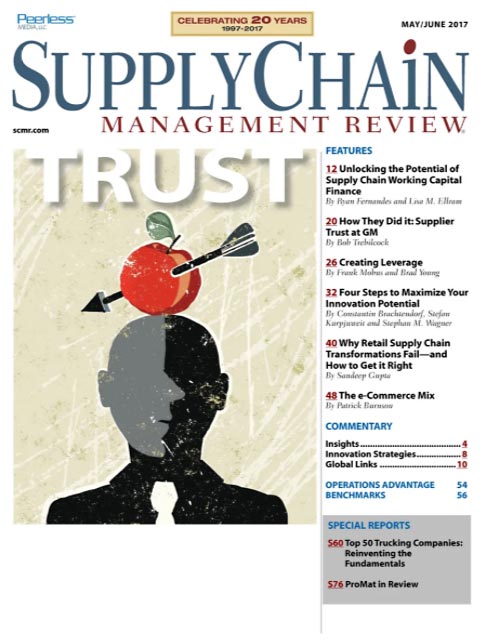
May-June 2017
Trust hasn’t always been an element in supplier relationships; all too often buyers have been encouraged to carry a big stick and get tough with suppliers to get the best price—no matter the cost. That approach to procurement is beginning to change. Browse this issue archive.Need Help? Contact customer service 1-508-503-1313 More options
Not every new product is a homerun like the iPhone. Some are underperformers like the 3-D television, or, worse yet, complete flops like the Samsung Galaxy Note 7.
Meanwhile, the number of new products is ever increasing as their life cycles decline. It was only a matter of months between Samsung’s complete withdrawal of the 7 and the grand introduction of the 8, which was quickly billed by pundits as more than enough to make people forget about its predecessor.
On a broader scale, between 1997 and 2012, product life cycles of fast moving consumer goods fell by 46% while the number of products increased 62%. In the same time period, the chemical industry’s new product introductions increased 313% while product life cycles fell 37%.

This complete article is available to subscribers only.
Log in now for full access or start your PLUS+ subscription for instant access.
SC
MR
Sorry, but your login has failed. Please recheck your login information and resubmit. If your subscription has expired, renew here.
May-June 2017
Trust hasn’t always been an element in supplier relationships; all too often buyers have been encouraged to carry a big stick and get tough with suppliers to get the best price—no matter the cost. That approach to… Browse this issue archive. Access your online digital edition. Download a PDF file of the May-June 2017 issue.Not every new product is a homerun like the iPhone. Some are underperformers like the 3-D television, or, worse yet, complete flops like the Samsung Galaxy Note 7.
Meanwhile, the number of new products is ever increasing as their life cycles decline. It was only a matter of months between Samsung's complete withdrawal of the 7 and the grand introduction of the 8, which was quickly billed by pundits as more than enough to make people forget about its predecessor.
On a broader scale, between 1997 and 2012, product life cycles of fast moving consumer goods fell by 46% while the number of products increased 62%. In the same time period, the chemical industry's new product introductions increased 313% while product life cycles fell 37%.
SC
MR


Latest Supply Chain News
- From salon to dock door: Repurposing scheduling software for inbound flow
- The biggest barrier to AI in supply chains isn’t technology
- Rebuilding a planning function around the physical world
- Why companies blame the wrong supplier … and miss the real failure
- NextGen Supply Chain Conference unveils agenda focused on AI, execution and the future of leadership
- More News
Latest Podcast
 Explore
Latest Supply Chain News
- Why companies blame the wrong supplier … and miss the real failure
- NextGen Supply Chain Conference unveils agenda focused on AI, execution and the future of leadership
- From fragmented negotiations to coordinated negotiation performance: an AI-enabled approach
- Supply chain resilience isn’t a data problem; it’s a judgment problem
- Beyond the hype: Building flexible and scalable supply chains in a VUCA world
- Why your supply chain risk management plan will fail
- More latest news
Latest Resources
Subscribe

Supply Chain Management Review delivers the best industry content.

Editors’ Picks



