
Europe is in reindustrialisation mode, with new EU-wide initiatives such as the Clean Industrial Deal and the Industrial Accelerator Act aimed at rebuilding strategic capacity and competitiveness. But while much of the policy debate is focused on energy costs and regulation, another vital factor requires attention: the reliable movement of goods within and through the continent.

European Commission president Ursula von der Leyen, in her address at this year’s World Economic Forum, pointed out that while capital and data can cross the continent in a second, business expansion is complicated by “a new set of rules every time” a company enters another EU Member State. This acts as “a handbrake” on growth and profit potential.
This problem with “a new set of rules every time” also applies to supply chain networks in Europe. When documentation, checks, capacity access and compliance differ across borders, lead times become harder to predict. Faced with that uncertainty, companies self-insure themselves: they carry more buffer stock and tie up more cash in working capital so factories and customers aren’t left waiting when the network stutters.
Rail freight: an underused strategic asset
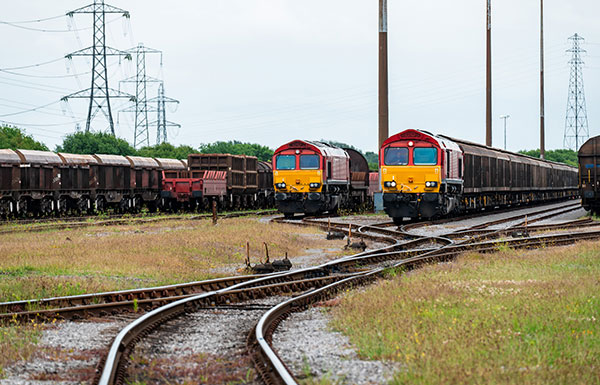
Rail freight illustrates this friction. With more than 200,000km of track in the European Union alone, Europe’s rail network should be its strategic strength; as the natural connector between ports and inland industrial regions, it is the obvious efficient, more sustainable alternative to congested road and water networks.
Yet for many cargo owners, cross-border rail is more challenging than it should be. Freight trains will run smoothly within one country and then lose hours during the planned transfer time at the border. It is no surprise that rail’s share of EU freight fell from 18.9% to 16.9% between 2018 and 2023, with only six countries increasing the modal share of rail freight between 2005 and 2023. The consequence of this is that reliability—a supply chain’s most valuable currency—suffers.
Turning plans into performance
Still, there is reason to hope we are at a turning point. The EU’s Trans-European Transport Network (TEN-T) sets out a continent-wide plan for transport corridors that link countries and modes, while the Connecting Europe Facility (CEF) provides the funding to build and upgrade the cross-border projects that make those corridors work in practice.
For example, the Brenner Base Tunnel targets a major north-south bottleneck between Austria and Italy and is designed to make cross-border rail slots predictable enough to compete with road, by replacing a steep, winding 19th-century mountain alignment with a nearly flat, straight base tunnel—increasing speed and load capacity, shortening the route, and cutting transit times. Rail Baltica does something similar in the north-east by building a route that connects Baltic ports and inland markets across Estonia, Latvia, Lithuania and Poland to the wider EU network.
At DP World, we are committed to this next generation of trade corridors. For example, in Romania, the recent expansion of the Port of Constanţa alongside our Aiud inland hub provides a direct, high-tech link between the Black Sea and Central Europe’s industrial centres. While at Southampton in the UK, our Modal Shift programme has removed 137,000 truck journeys from the road in little over a year using the UK’s underutilised rail network to connect businesses to customers faster.
However, a world-class tunnel or port is only as reliable and efficient as the digital systems governing it. These systems must be interoperable, which is what the Electronic Freight Transport Information (eFTI) framework seeks to achieve. By replacing paper-based friction with a unified digital exchange, the eFTI could save the transport sector an estimated €1 billion annually in admin and compliance costs. This is promising, yet mandatory acceptance of digital freight data will not apply across all EU Member States until mid-2027.
Data, decarbonisation and delivery
One further reason to get the physical and digital layers right now is the EU’s carbon policy. Under the expanded Emissions Trading System 2 (ETS2), BloombergNEF projects average EU road-transport fuel prices could rise by almost one-third by 2030, potentially adding €0.50 per litre of fuel. In that environment, a reliability gap also quickly becomes a cost gap, and the case for switching to more sustainable multimodal routes strengthens.
So we have the diagnosis. We have signs of action. But there’s a lot more to be done. Deutsche Bank analysis shows that of the 900 measures recommended by the landmark 2024 Draghi report to fix our supply chains, only 11% are in place.
To restart Europe's industrial engine, the public sector must take the lead: standardise rail to work across borders; treat data as a utility by fast-tracking digital freight standards (eFTI); and fund more corridors that move goods. But the private sector cannot wait on policy alone. Whether you’re a cargo owner or port operator, now is the time to invest in getting the digital and physical layers future-ready.
Europe’s competitiveness depends on the ability to deliver on its extraordinary growth potential. The assets are there, we now need to ensure that the connection is there as well. We might not be able to move goods as fast as capital and data, but there’s no reason why we shouldn’t aspire to have them follow closely behind.
About the author
Rashid Abdulla is CEO and MD of DP World Europe where he oversees a pan-European network spanning ports and terminals, contract logistics and freight services. He previously led the Asia Pacific region and served as SVP Global Operations at DP World’s Head Office.
SC
MR

More Logistics Strategy
- Europe’s industrial future will be won or lost in its logistics networks
- The new logistics playbook for consumer and retail growth
- A reordering of the COO and CSCO logistics agenda
- A reordering of the COO and CSCO logistics agenda
- Is Amazon’s secret to revolutionizing logistics the willingness to say yes?
- More Logistics Strategy
 Explore
Topics
Procurement & Sourcing News
- Why companies blame the wrong supplier … and miss the real failure
- NextGen Supply Chain Conference unveils agenda focused on AI, execution and the future of leadership
- From fragmented negotiations to coordinated negotiation performance: an AI-enabled approach
- Supply chain resilience isn’t a data problem; it’s a judgment problem
- Why your supply chain risk management plan will fail
- When component verification becomes operational
- More Procurement & Sourcing
Latest Procurement & Sourcing Resources

Subscribe

Supply Chain Management Review delivers the best industry content.

Editors’ Picks



