
Sorry, but your login has failed. Please recheck your login information and resubmit. If your subscription has expired, renew here.
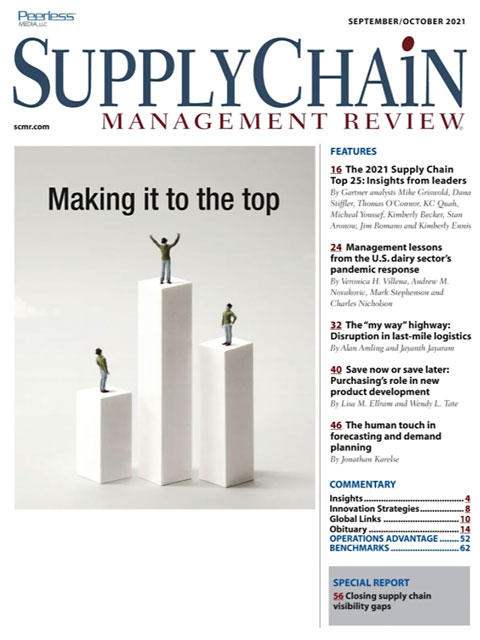
September-October 2021
This time every year, we publish Gartner’s Top 25 supply chains, the annual list of the supply chains that have made it to the top, a list that now also includes 5 Masters, or companies that have consistently outperformed year after year. You can read the article in this issue, along with the web exclusive material we publish on scmr.com, to find out what it takes to become a supply chain leader. Browse this issue archive.Need Help? Contact customer service 1-508-503-1313 More options
Artificial Intelligence and Machine Learning (ML) are affecting many areas of supply chain management, including the use of key performance indicators (KPIs).
As critical measures of operational performance, KPIs are fundamental to the efficiency of supply chains. Artificial Intelligence (AI) and Machine Learning (ML) can reshape the way KPIs are chosen and applied and facilitate the development of new ones. KPIs also play an important role in guiding AI/ML projects to successful outcomes.
The role of KPIs
In AI, an algorithm or robot performs cognitive functions that are typically associated with the human mind, such as learning or interacting with the environment. These algorithms or robots require anchor points when analyzing a situation or process.
KPIs provide the anchor points in AI/ML projects by helping to define what outcomes we should expect when using the models to, say, improve a supply chain process. In that regard, the aggregated layers of KPIs provide a structure for decision-making and become critical to the success of the project.
Performance indicators also anchor the complex data sets that AI/ML models analyze and interpret. This is particularly important when the objective is the digital transformation of the supply chain, projects that typically draw data from many disparate sources.
These layers of data represent different units and entities and must be connected end-to-end if the project is to achieve its goals. An example of such a unit is an SKU, which may be represented in terms of how it is manufactured, which logistics services provider delivers it over the last mile or even the contracts that frame these services. Because performance is measured in these different contexts, a KPI, or anchor point, ties the multiple data layers together.
Think of streams of data as strands that run through the end-to-end supply chain to form a multi-layered fabric. The KPIs are like buttons or fasteners that link the different layers together.
Linking AI/ML with KPIs
AI/ML coupled with performance indicators can be a powerful combination when the goal is to improve a supply chain process or achieve across-the-board efficiencies.

This complete article is available to subscribers only.
Log in now for full access or start your PLUS+ subscription for instant access.
SC
MR
Sorry, but your login has failed. Please recheck your login information and resubmit. If your subscription has expired, renew here.
September-October 2021
This time every year, we publish Gartner’s Top 25 supply chains, the annual list of the supply chains that have made it to the top, a list that now also includes 5 Masters, or companies that have consistently… Browse this issue archive. Access your online digital edition. Download a PDF file of the September-October 2021 issue.Artificial Intelligence and Machine Learning (ML) are affecting many areas of supply chain management, including the use of key performance indicators (KPIs).
As critical measures of operational performance, KPIs are fundamental to the efficiency of supply chains. Artificial Intelligence (AI) and Machine Learning (ML) can reshape the way KPIs are chosen and applied and facilitate the development of new ones. KPIs also play an important role in guiding AI/ML projects to successful outcomes.
The role of KPIs
In AI, an algorithm or robot performs cognitive functions that are typically associated with the human mind, such as learning or interacting with the environment. These algorithms or robots require anchor points when analyzing a situation or process.
KPIs provide the anchor points in AI/ML projects by helping to define what outcomes we should expect when using the models to, say, improve a supply chain process. In that regard, the aggregated layers of KPIs provide a structure for decision-making and become critical to the success of the project.
Performance indicators also anchor the complex data sets that AI/ML models analyze and interpret. This is particularly important when the objective is the digital transformation of the supply chain, projects that typically draw data from many disparate sources.
These layers of data represent different units and entities and must be connected end-to-end if the project is to achieve its goals. An example of such a unit is an SKU, which may be represented in terms of how it is manufactured, which logistics services provider delivers it over the last mile or even the contracts that frame these services. Because performance is measured in these different contexts, a KPI, or anchor point, ties the multiple data layers together.
Think of streams of data as strands that run through the end-to-end supply chain to form a multi-layered fabric. The KPIs are like buttons or fasteners that link the different layers together.
Linking AI/ML with KPIs
AI/ML coupled with performance indicators can be a powerful combination when the goal is to improve a supply chain process or achieve across-the-board efficiencies.
SUBSCRIBERS: Click here to download PDF of the full article.
SC
MR


Latest Supply Chain News
- 4 moves supply chains must make as AI triggers a memory supply shock
- Innovators Netstock, Pickle Robot win NextGen Solution Provider awards
- Bigger trucks versus broken bridges and roads
- From salon to dock door: Repurposing scheduling software for inbound flow
- The biggest barrier to AI in supply chains isn’t technology
- More News
Latest Podcast
 Explore
Topics
Software & Technology News
- Innovators Netstock, Pickle Robot win NextGen Solution Provider awards
- The biggest barrier to AI in supply chains isn’t technology
- NextGen Supply Chain Conference unveils agenda focused on AI, execution and the future of leadership
- From fragmented negotiations to coordinated negotiation performance: an AI-enabled approach
- Beyond the hype: Building flexible and scalable supply chains in a VUCA world
- Managing human and AI teams across the supply chain
- More Software & Technology
Latest Software & Technology Resources
Subscribe

Supply Chain Management Review delivers the best industry content.

Editors’ Picks



