
A planner walks into a morning operations meeting with three dashboards open. One shows excess inventory, another signals potential stockouts, and a third highlights rising logistics costs. Each is accurate. None leads to a clear decision. The first half of the meeting is spent reconciling numbers. The decision is delayed or escalated. Everyone has the data, but no one owns the decision.
This situation is no longer unusual. Over the past few years, companies have invested heavily in control towers, real-time visibility tools, predictive analytics, and AI. The expectation was straightforward: more data would enable faster and better decisions. Instead, many organizations are experiencing slower decision cycles, more alignment meetings, and increased hesitation. The problem is no longer data scarcity. It is how decisions are made in a data-rich environment. Supply chains are becoming data-rich but not decision-ready.
Why more data is not leading to better decisions
This issue has become more visible as supply chains operate under continuous disruption, where volatility is no longer episodic but structural. In this environment, speed matters as much as accuracy, because a delayed response to a disruption can quickly erase the value of even the most accurate forecast.
At the same time, expectations around “data-driven decisions” have shifted. Leaders are now expected to justify actions with analytics, not just experience. While this improves transparency, it also introduces friction, as decisions are validated, rechecked, and aligned across functions before anyone commits to a course of action. Many organizations now face what a recent industry report describes as an “insight-to-action gap,” where the ability to generate insights exceeds the ability to act on them in time. The underlying issue is not data quality but that decision processes have not evolved at the same pace as data capabilities.
Where decisions break down
Across organizations, similar patterns appear. First, metrics often conflict. Procurement may focus on cost, operations on throughput, and customer‑facing teams on service levels. Each function works with accurate data, but there is no clear rule for which metric takes priority when trade-offs arise. Targets are met locally while the end-to-end decision stalls, and meetings are spent defending metrics rather than choosing a path. Teams optimize locally, but the organization cannot decide globally.
Second, decision ownership is often unclear. Data is widely accessible, but authority is not. Multiple teams can see the same issue, yet no one is clearly accountable for acting on it. Planners hesitate, managers forward issues to peers, and problems travel “up and sideways” until someone senior feels compelled to step in. This creates hesitation, frequent escalation, and a culture where analysis moves faster than decisions. Issues move faster than authority.
Third, more data introduces more validation. Leaders seek confirmation across systems before committing to a decision, asking for one more report, another scenario, or a cross‑check from a different team. While this reduces risk in isolated cases, it slows the organization. Speed is traded for certainty, even when certainty is unattainable. Over time, people learn that it is safer to ask for more data than to decide with the information already available. These patterns reinforce each other. More visibility exposes differences in priorities. Differences require alignment. Without clear ownership, alignment becomes escalated. The result is slower decision‑making despite better information.
The issue can be summarized simply:
| Symptom | What It Looks Like | Root Cause | Leadership Focus |
|
Conflicting signals |
Different dashboards suggest different actions |
Misaligned KPIs |
Define metric hierarchy |
|
Slow decisions |
Repeated validation and meetings |
Unclear ownership |
Assign decision rights |
|
Frequent escalation |
Decisions pushed upward |
Lack of accountability |
Clarify authority at the right level |
When decisions catch up to data
Some organizations are addressing this gap by designing decisions first, and data second. UPS’s Harmonized Enterprise Analytics Tool (HEAT) is often cited for its analytics capabilities. Its impact, however, comes from how it supports specific operational decisions such as routing and capacity allocation. HEAT ingests more than a billion data points per day to create a single view of network performance and feeds that into planning and management routines that adjust how packages move through the network in near real time. Rather than presenting all available data, the platform emphasizes what matters most for those decisions and embeds it in day‑to‑day operations.
PepsiCo took a similar approach with its sales intelligence platform. Instead of building a broad analytics hub, the company focused on a single decision: predicting and preventing out‑of‑stocks at the store level. Its AI‑driven demand forecasting, developed with partners such as TAZI, has achieved about 98% accuracy for most products and reduced truck stock‑outs by roughly 4%, while improving order size and product mix on delivery routes. By tying analytics to a concrete decision and playbook, PepsiCo made it easier for teams to act quickly rather than simply observe more data.
Pfizer’s Global Supply Digital Operations Center also illustrates this shift. The DOC functions as a virtual cockpit for manufacturing and supply, providing a shared, end‑to‑end view of operational performance across sites. Pfizer reports that the DOC has helped reduce cycle time in some areas and, more importantly, has “transformed how manufacturing colleagues collaborate and make decisions,” enabling teams to predict issues before they occur and adjust in real time. The emphasis is not on adding more dashboards, but on speeding and coordinating interventions where they matter most. In each case, technology is important, but the design principle is more important. Data is organized around decisions, not the other way around.
Making supply chains decision-ready
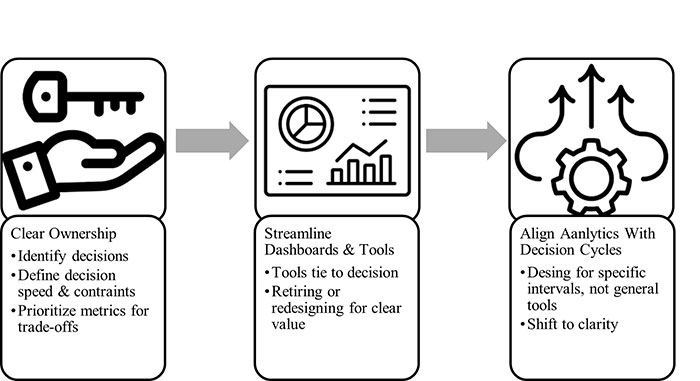
For supply chain leaders, the key question is no longer how to improve visibility. It is how to improve decision speed and clarity. Figure 1 shows a supply chain decision-making pathway. A practical starting point is to identify a small set of critical decisions where speed matters most, such as disruption response, allocation across channels, or supplier adjustments. For each decision, three elements should be clearly defined: who owns the decision, how quickly it needs to be made, and which metrics take priority when trade-offs occur. Writing these down and socializing them turns vague “data-driven” expectations into an explicit playbook.
Leaders should also examine the dashboards and tools used in operations. Each should be tied to a specific decision and cadence. If a dashboard does not clearly answer “what action should be taken,” it is adding noise rather than value. In many organizations, simply retiring or redesigning a few widely used dashboards removes friction and reduces time spent reconciling numbers.
Finally, analytics efforts should be aligned with decision cycles. Instead of building general-purpose tools, organizations should design analytics to support specific decisions at defined intervals. This shift forces clarity about what information is necessary and what is sufficient to act, and it helps analytics teams measure success in terms of faster, better decisions rather than the number of reports delivered.
Figure 1: Supply Chain Decision Making Pathway
From data-rich to decision-ready
Most supply chains have already solved the problem of visibility. The next challenge is execution. Organizations that continue to invest primarily in data capabilities may see diminishing returns. Those that focus on how decisions are made will move faster and respond more effectively to disruption. The advantage is no longer having more data. It is the ability to act on it. Most supply chains do not lack data. They lack clarity on who decides, how fast, and based on which signals.
About the author
Corrine Chen is an educator, researcher, and former industry executive with over a decade of hands-on experience in supply chain management, procurement, and innovation. She teaches supply chain management courses at the University of Nebraska Omaha. Corrine’s work bridges academia and practice, with published research, applied projects, and a passion for empowering the next generation of supply chain professionals. She can be reached at [email protected].
SC
MR


More Data-Driven Decision Making
 Explore
Topics
Procurement & Sourcing News
- Why companies blame the wrong supplier … and miss the real failure
- NextGen Supply Chain Conference unveils agenda focused on AI, execution and the future of leadership
- From fragmented negotiations to coordinated negotiation performance: an AI-enabled approach
- Supply chain resilience isn’t a data problem; it’s a judgment problem
- Why your supply chain risk management plan will fail
- When component verification becomes operational
- More Procurement & Sourcing
Latest Procurement & Sourcing Resources

Subscribe

Supply Chain Management Review delivers the best industry content.

Editors’ Picks



