
Sorry, but your login has failed. Please recheck your login information and resubmit. If your subscription has expired, renew here.
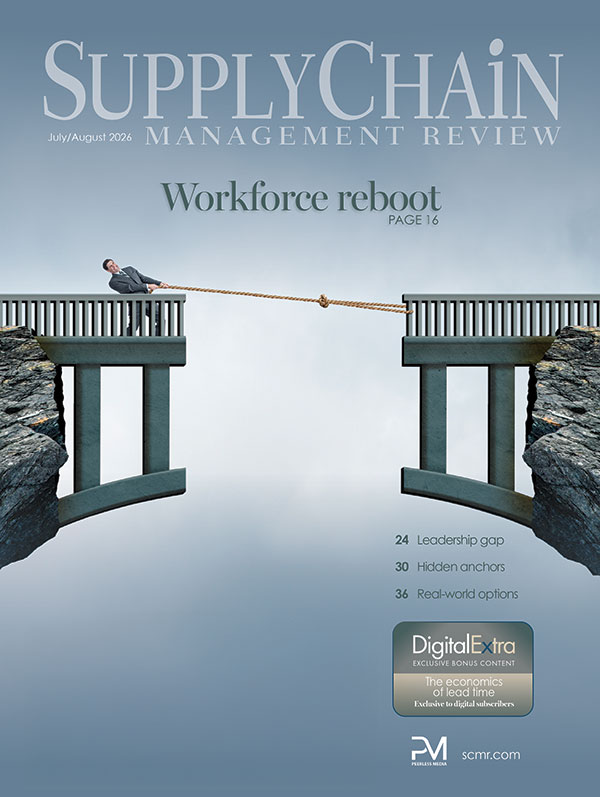
July-August 2026
The July issue of Supply Chain Management Review explores how organizations are preparing for the future through workforce development, AI adoption, leadership education, and supply chain resilience. Features examine closing the skills gap, building AI-enabled teams, strengthening supplier networks, and developing practical strategies for navigating disruption in an increasingly complex global marketplace. Browse this issue archive.Need Help? Contact customer service 1-508-503-1313 More options
With all the hubbub about the Strait of Hormuz being a chokepoint these days, I’ve begun to wonder whether supply chain managers have been thinking hard enough about bottlenecks in their global supply chains. When I was an analyst at AMR Research (now part of the Gartner Group)—focused on Advance Planning and Scheduling (APS) software—I learned a bit about “The Theory of Constraints” (TOC). It is “an overall management philosophy introduced by Eliyahu M. Goldratt in his 1984 book The Goal that [is] geared to help organizations continually achieve their goals. It describes a case study in operations management, focusing on the ‘Theory of Constraints’ and bottlenecks in addition to how to alleviate them,” according to a Wikipedia entry describing it.
SC
MR
Sorry, but your login has failed. Please recheck your login information and resubmit. If your subscription has expired, renew here.
With all the hubbub about the Strait of Hormuz being a chokepoint these days, I’ve begun to wonder whether supply chain managers have been thinking hard enough about bottlenecks in their global supply chains. When I was an analyst at AMR Research (now part of the Gartner Group)—focused on Advance Planning and Scheduling (APS) software—I learned a bit about “The Theory of Constraints”(TOC). It is “an overall management philosophy introduced by Eliyahu M. Goldratt in his 1984 book The Goal that [is] geared to help organizations continually achieve their goals. It describes a case study in operations management, focusing on the ‘Theory of Constraints’ and bottlenecks in addition to how to alleviate them,” according to a Wikipedia entry describing it.
Because a chokepoint appears to be a bottleneck that has been shut down for an indefinite amount of time, I wondered what are ways in which a global supply chain might be designed to temper the impact of a random chokepoint popping up in one’s supply chain.
Design irrespective of possible future supply happenings
Fourteen years ago in my Insights column, “Don’t Forget Supply-Side Risk” (July/August 2012), I cautioned managers against assuming that only the demand side of their business has risks and uncertainties associated with it. The subtitle stated that: “As the global environment becomes more uncertain, managers need to pay greater attention to risks on the supply side.”
In it, I stated that supply chain managers have always been reconciled to the fact that customers are fickle. They understand that demand is uncertain, thus forecasts and plans are invariably inaccurate. They’ve become adept at coping with demand uncertainty and risk by using various buffering strategies, including the deployment of inventory safety stock. However, when it comes to understanding and managing uncertainty and risk on the supply side, they are typically far less accomplished or even concerned.
Back in the day, I debated a seasoned and accomplished supply chain manager on the topic. He agreed with my view that demand-side uncertainty might increase significantly because of a financial crunch (i.e., the Great Recession that had happened at that time). However, he refused to accept that the same could happen on the supply side. He could not envision any supply-side uncertainties that he couldn’t manage around—and the audience wholeheartedly agreed with him.
Supply disruptions became more prevalent
In my column, I mentioned several examples of this supply-side uncertainty and risk. The Japanese tsunami and the Thai floods, back then, disrupted the high-tech and automobile supply chains for quite some time. The Arab Spring caused the disruption of supply chains in some Middle East countries. Several Latin American countries such as Venezuela, Argentina and Bolivia were more inclined to nationalize businesses. Also, pirates disrupted supply lines off the coast of Somalia. Lastly, politicians around the world were expressing concern about the unemployment of domestic workers, putting outsourcing and offshoring programs at risk.
Since then, the world experienced the COVID-19 pandemic that rendered both demand and supply more uncertain and riskier for quite some time. For example, there were serious shortages of vital medical masks and baby formula—primarily due to the outsourcing of production to remote outsourcers—and the lockdowns that kept people from going to work.
Chokepoint: A Strait of Hormuz lesson
As a result of the recent war with the U.S., Iran created an oil supply chain chokepoint in the Strait of Hormuz in which a significant percentage of the world’s oil passes. It drove up energy prices at high economic costs to the world in order to put pressure on the U.S. during ceasefire negotiations. Since modern economies rely heavily on, and are actually addicted to fossil fuels, the higher energy costs and inflation are a significant concern among economists.
At one point, around 600 tankers were stuck in the strait. To my simple mind, this is unbelievable. Why did transportation managers and executives allow it to reach this crisis level? Did any of them ever take a detour in their car to avoid a severe traffic jam—especially a potentially deadly one for their sailing teams?
Coincidentally, a timely book from Edward Fisher, titled Chokepoints: American Power in the Age of Economic Warfare, was recently published. According to Amazon.com it is:
- The epic story of how America turned the world economy into a weapon, upending decades of globalization to confront a new authoritarian axis—Russia, China, and Iran. (The New York Times)
- Chokepoints provides a thrilling account of one of the most transformative developments of our time, demystifying how the U.S. government harnesses the power of Wall Street, Silicon Valley, and Big Oil against America’s enemies. At the center of the narrative are the trailblazing diplomats, lawyers, and financial whizzes who have masterminded America’s escalating economic wars against Russia, China, and Iran.
The book extends the idea of geographic chokepoints—including the Bosporus and the Strait of Hormuz—that are critical domains of the global economy dominated by the United States and its allies. Fishman argues that these chokepoints give Washington extraordinary leverage, while cautioning that their exploitation is driving U.S. adversaries to construct alternatives (Wikipedia).
In a news article, “In This War, Chokepoints Beat Tariffs” (WSJ, April 15, 2026), a reporter states that: “Neither Iran nor even China possess anything like the economic sway the U.S.
does. What they control are “chokepoints”—China produces 94% of rare-earth magnets and 20% of the world’s oil passes through the Strait of Hormuz.” Also, “as finance and supply chains have globalized, potential economic chokepoints have multiplied, as have the efforts to weaponize them.”
Also, “Fishman notes that once a chokepoint has been weaponized, vulnerable nations will go to great lengths to neutralize it.” For example, in an article, “Trucks Circumvent Hormuz Barrier” (WSJ, May 13, 2026), the subtitle states that “With strait jammed, overland shipping is next best option, a logistical lifeline. Highways, railroads, and ports in Saudi Arabia, the United Arab Emirates, and Oman have been transformed into an emergency logistics lifeline circumventing the Strait of Hormuz waterway.”
The Theory of Constraints (TOC) might be useful
“The Theory of Constraints [TOC] is a management paradigm that views any manageable system as being limited in achieving more of its goals by a very small number of constraints. There is always at least one constraint, and TOC uses a focusing process to identify the constraint and restructure the rest of the organization around it. TOC adopts the common idiom that ‘a chain is no stronger than its weakest link.’ That means that organizations and processes are vulnerable because the weakest person or part can always damage or break them, or at least adversely affect the outcome,” according to Wikipedia.
Use buffering to mitigate bottleneck risk
TOC deals with bottlenecks. According to Wiktionary.com, two of the definitions of bottleneck (with chokepoint being synonymous) are: 1) “In traffic, any narrowing of the road, especially resulting in a delay,” and 2) “The part of a process that is too slow or cumbersome.”
Thus, in looking at a global supply chain involving multiple tiers of upstream suppliers to downstream sellers, troubled bottlenecks can significantly impede the flow of goods. In TOC nomenclature, bottlenecks are termed constraints. Buffers are used around a severe bottleneck to protect it against upstream (supply) and downstream (demand) vagaries. The Insights column “How Buffers Can Mitigate Risk” (April 2008), discussed one important solution to coping with uncertainties is to plan with them in mind, and put in place more efficient ways of coping with them. Leveraging risk management during planning is a way to build in the appropriate levels of agility, adaptability, flexibility, and responsiveness.
Variability Buffering Law
One of the laws found most useful for enabling risk management in supply chains is called the “Variability Buffering Law.” It states that “variability in a production system will be buffered by some combination of inventory, capacity, and time.” The law helps identify methods for adding buffers needed for sustaining performance that also mitigate against future uncertainties. Here are some examples:
- Inventory. Inventory is the most prevalent buffering method. The concept of safety stocks is well understood among supply chain managers. In addition, formal techniques exist for setting safety stocks based on uncertain supply lead times and demand uncertainties to achieve customer service-related performance goals. To ensure maximum use of bottlenecked assets, TOC prescribes using inventory buffers in front (e.g., the upstream side) of these assets based on the uncertainties of supply activities. As well as often buffering behind (e.g., the downstream side) to mitigate against the risk of significant vagaries in demand.
- Capacity. The concept of not using 100% of capacity is intuitively unappealing. However, when things do not go according to plan in a system running at 100%, havoc can ensue. Should there be any upticks in demand or supply glitches, inordinate delays will occur. Thus, from a practical standpoint, operations are utilized significantly below their theoretical maximum. Leveraging the Variability Buffering Law, for example, running two shifts with a capability to run a third is one way to buffer against supply shortages or upticks in demand. Building redundancy in a system can also effectively buffer via capacity. For example, designing a plant with the capability to switch production among multiple products, or multi-task workers, or use multiple suppliers for a component, effectively increases capacity by providing options to apply additional supply resources to products experiencing higher-than-expected demand relative to others.
- Time. Allowing extra time to take action, make a decision, or service a customer are ways to buffer against variability. For example, manufacturing postponement buffers against demand risk by delaying the defining steps in the manufacturing process of a product until demand is better known. Delaying distribution by holding inventory upstream until absolutely necessary or re-directing goods in-transit are better ways to match variability in demand geographically. “Service window management” schemes also leverage time buffers. These involve padding the delivery time quoted to customers so that more time is available to service them should glitches occur during order fulfillment. For example, many parcel carriers quote a delivery time range, such as within five days. Other companies quote an order delivery by adding days or weeks to their average fulfillment times to account for uncertainty in supply operations.
The Hormuz chokepoint evolved to a disaster waiting to happen
Research for the MIT Supply Chain 2020 project I managed the launch of in 2005 included the profiling of supply chains in a variety of industries. In the auto industry, GM was picked as a topic for a graduate student’s thesis. In a draft of it, the company’s sponsor saw that one of the best practices that was profiled was “state-side” inventory.
This was holding inventory of cars in the U.S. to buffer against the vagaries of the ocean shipping of cars manufactured overseas. The student was told to take it out of the published thesis because the supply chain managers had instituted the policy without running it by executive management. Often focused on return-on-assets, the executives wanted to run a lean, just-in-time (JIT) supply chain, holding minimal inventory, especially in the United States.
TOC might have helped mitigate the chokepoint
Middle East oil producers appear to have evolved to a lean, JIT oil supply chain. With (apparently) little thought to using inventory, capacity, and time buffers to mitigate against various vagaries in supply and demand. For example, producers held all their oil inventory in-country, assuming that the Strait would always be wide open for order fulfillment. More inventory should have been held nearer to downstream customers in other geographic areas of the world (think about GM’s state-side inventory example). Also, there was insufficient excess pipeline ‘capacity’ in their country to move oil without using the Strait. Lastly, they should have promised customers longer and more flexible (e.g., extended) lead times just in case tankers needed to be detoured, rather than (too-often) directed into the closed and dangerous Strait of Hormuz.
Bottom line: Apparently, too little oil inventory was in-transit and not stored outside the Middle East. In retrospect, wouldn’t it have been better to have up to 60 days or more of oil demand on tankers and in storage elsewhere so that customers would be served for at least 60 days, while the producers figured out detours away from the Strait? •
SC
MR


More Geopolitical Risks
- Chokepoints need the ‘Theory of Constraints’
- Advancing the enterprise in volatile times: Supply chain as a source of reason
- Procurement leaders grapple with ESG, AI, and geopolitical risks
- Gartner survey reveals AI, ESG and geopolitics top supply chain influences
- Businesses see some dark clouds
- More Geopolitical Risks
What's Related in Geopolitical Risks
 Explore
Topics
Procurement & Sourcing News
- Innovators Netstock, Pickle Robot win NextGen Solution Provider awards
- From salon to dock door: Repurposing scheduling software for inbound flow
- The biggest barrier to AI in supply chains isn’t technology
- Rebuilding a planning function around the physical world
- Why companies blame the wrong supplier … and miss the real failure
- NextGen Supply Chain Conference unveils agenda focused on AI, execution and the future of leadership
- More Procurement & Sourcing
Latest Procurement & Sourcing Resources
About the Author
Larry Lapide, Research Affiliate

Dr. Lapide is a lecturer at the University of Massachusetts’ Boston Campus and is an MIT Research Affiliate. He received the inaugural Lifetime Achievement in Business Forecasting & Planning Award from the Institute of Business Forecasting & Planning. Dr. Lapide can be reached at: [email protected].
Follow SCMR on social media.
@SupplyChainManagementReview on Facebook
@SCMR on Twitter
SCMR on Linkedin
Subscribe

Supply Chain Management Review delivers the best industry content.

Editors’ Picks



