
I was teaching a workshop last week in Harrison, Arkansas and arrived early the day before. With an extra few hours to kill, I decided to drive around Harrison’s main street which included lunch at the Dixie Café and a stop at Wal-Mart.
It’s been a while since I’ve been inside a Wal-Mart store, but I am familiar with Wal-Mart’s procurement processes in China, so I decided to conduct a fun little experiment. I picked up 22 random items and looked for the Country of Origin on each item. Of these, 19 were labeled “Made in China”, 2 were “Made in El Salvador,”, and 1 was “Made in India.” I made an effort to find anything that was labeled “Made in the USA” and eventually found a couple of things. I also tried to find the new 1880 towels that have been all over the news because production of these towels was reshored from China to Georgia. These towels are supposed to be carried at Wal-Mart stores. But there weren’t any in this store.
The assortment of Chinese merchandise was astounding. Even I was surprised, knowing that 40% of the world’s goods are manufactured in China. But to see it on the racks, on the shelves, stacked in aisles and on hangers was a real eye-opener. We demand rock-bottom prices on the things we buy and as a result, Wal-Mart turns to low-cost producers in China, and fills its stores with Chinese merchandise. But Wal-Mart has also earmarked $50 billion to buy goods from US manufacturers over the next decade. Wal-Mart is on board to try and shift the tide back to America.
If we truly want to bring manufacturing back to the US, we have a very long way to go. In January, my consulting firm rolled out a new product called “Bring Manufacturing Back.” It’s a 6-week program to help our clients evaluate what they could make in the US. This process is not as simple as it appears. There are so many aspects including costs, technologies, skills, localization, government incentives and others. It is also important to evaluate what a company should keep manufacturing in China for the burgeoning Chinese market.
I sense there is a real shift in thinking as senior operations and supply chain executives take a giant step up and consider their global manufacturing strategy, not just the cheapest production environment. It seems to me, this is the next evolution in global supply chains.
SC
MR

Latest Supply Chain News
- From salon to dock door: Repurposing scheduling software for inbound flow
- The biggest barrier to AI in supply chains isn’t technology
- Rebuilding a planning function around the physical world
- Why companies blame the wrong supplier … and miss the real failure
- NextGen Supply Chain Conference unveils agenda focused on AI, execution and the future of leadership
- More News
Latest Podcast
 Explore
Topics
Latest Supply Chain News
- Innovators Netstock, Pickle Robot win NextGen Solution Provider awards
- Bigger trucks versus broken bridges and roads
- From salon to dock door: Repurposing scheduling software for inbound flow
- The biggest barrier to AI in supply chains isn’t technology
- Rebuilding a planning function around the physical world
- Why companies blame the wrong supplier … and miss the real failure
- More latest news
Latest Resources
About the Author
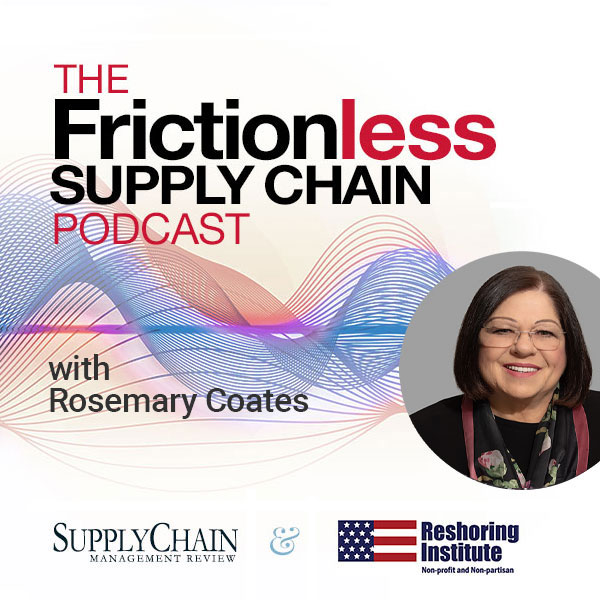
Rosemary Coates, Exec. Dir. Reshoring Institute

Ms. Coates is the Executive Director of the Reshoring Institute and the President of Blue Silk Consulting, a Global Supply Chain consulting firm. She is a best-selling author of five supply chain management books including: 42 Rules for Sourcing and Manufacturing in China and Legal Blacksmith - How to Avoid and Defend Supply Chain Disputes. Ms. Coates lives in Silicon Valley and has worked with over 80 clients worldwide. She is also an Expert Witness for legal cases involving global supply chain matters. She is passionate about Reshoring.
Follow SCMR on social media.
@SupplyChainManagementReview on Facebook
@SCMR on Twitter
SCMR on Linkedin
Subscribe

Supply Chain Management Review delivers the best industry content.

Editors’ Picks



