
Editor's Note: This article first appeared in the January 2024 issue of Supply Chain Management Review. For more content like this, click here to subscribe to either the print or digital edition of the magazine.
Supply chains lack the required “high-fidelity” data and capabilities to operate in today’s complex business climate that is characterized by excessive supplier and logistics risks and disruptions, rapidly evolving sustainability and geopolitical requirements, growing implications of customer centricity, and hybrid channels to market. Successful organizations must pursue a different approach to innovate and re-invent their supply chains. Firms that cannot will fail as they are characterized by flatlined revenues, longer lead times, bloated inventory, and shrinking margins with surging SG&A (selling, general, and administrative) costs.
The role of supply chains has significantly evolved from the basic needs of satisfying customers (1990s), to servicing global markets (2000s), to driving profitability (2010s), to enabling customer centricity and differentiation while managing complexity in today’s markets. Managing complexity, whilst enabling resilience, is the operative phrase as supply chains today are a CEO and board-level mandate with a focus on reinvention, with more change in the last four years than in the previous 40 years. The success and evolution of all companies are underpinned by creating new high-fidelity supply chains with a forward-looking lens that incorporates three critical success factors (CSF) to future-proof organizations and enable resilience.
Based on extensive academic research and extensive industry experience, we apply these three factors discussed below, using a new approach to drive your next-gen supply chain transformation strategy. By understanding and incorporating these factors, supply chain transformation strategies can pivot from the traditional top-down, large-scale, process-driven reengineering approaches that lack agility and results.
The three critical success factors (CSFs) are described below.
1. High-fidelity supply chains must operate in a more dynamic environment that concurrently manages multiple complexities using big data. Creating a digital supply chain that enables customer centricity just got a lot more challenging. Customer-centric strategies once focused on integrated demand-and-supply planning, B2B supplier collaboration, smart factories, and multi-channel fulfillment with predictive ETAs. They now must quickly pivot to recalibrate and incorporate other critical aspects of the end-to-end supply chain simultaneously. The stakes have become much higher today and go beyond traditional margin improvement and inventory reductions, putting top-line revenue at risk. Consumers expect organizations to provide a seamless channel experience along with personalization and frustration-free fulfillment.
COVID-19 universally exposed single-threaded, globally optimized supply chains across all industries. As supply chains are reconfigured to deliver regionalized capabilities with alternative sources of supply and local logistics partners, complexity is increased. The growth and shift of B2B and an e-commerce channel during COVID are a permanent shift from traditional incumbent and retailer channels—a 46% growth in digital commerce in two years and 333% growth in online grocery in four years according to a January 2023 Forbes article—yet profitable and efficient fulfillment of higher velocity, more frequent smaller quantities remain elusive (less than full truckload/full pallets).
In life sciences, global supply chains are being regionalized to mitigate disruption of active product ingredients sourced from China and India, while cold chain and vile/unit level track and trace are needed for effective vaccine distribution and growth in personalized and specialized medicine. Healthcare providers must modernize and reinvent supply chains to address rising costs, nursing and other labor shortages, and the rise of direct-to-patient care. Well-publicized severe shortages of key materials including semiconductors, compounded by geopolitical risk, have affected automotive, high tech and other manufacturing industries in the pursuit of smarter connected products.
This problem will be exacerbated with subsequent shortages of key raw material commodities including plastic, cardboard, copper, rubber, lithium, cobalt, and magnesium, among others that have different procurement models. Changing demand, internal and external disruption, workforce contraction, and rapid shifts in channel-to-market are challenging and changing every part of a company’s operations.
Adding to all this change is the growing importance of sustainability requirements that will intensify the need for visibility at a transactional level to ensure compliance. Organizations, especially in the automotive sector where precious metals and commodities are used, are identifying circular economy opportunities to recycle metals, e.g. those used in battery production and use, and come up with innovative subscription and leasing models within the automotive sector. Germany is taking the lead but others are sure to follow with a new law now in place that requires companies to regularly and systematically identify and address human rights and environmental risks in their supply chains.
Penalties follow a similar approach to data privacy laws, which are uncapped and based on revenues. That is sure to get the attention of CEOs. Apple’s recent iPhone releases are another example where the excluded power adapter demonstrates the cross-functional impact on new product design, supply chain planning, procurement, warehousing and logistics. The aperture for supply chain reinvention now must include e-waste, more environmentally friendly packaging, and logistics that alleges 70% more product per pallet.
2. Business model needs to go through a serious evolution. In addition to the dynamic external environment, survival also requires the business model to rapidly evolve to consider the impact of regionalization and personalization, design of intelligent products, and new consumption models. This means investing in more dynamic channel models with an ever-changing supply base and collaboration ecosystem along with segmentation of products, customers and channels to operationalize strategies around localization, built-to-order versus make-to-stock, dynamic pricing, and other strategies to differentiate service offerings across the end-to-end customer journey.
Servicing this end-to-end customer journey and the experience a customer receives when conducting a transaction (transaction utility) has become a strategic differentiator beyond the sole focus on the quality of the product produced and purchased (product utility). Shorter disruptive business cycles make product differentiation increasingly difficult to sustain, diminishing the product utility. As channel-to-market blurs (B2B/B2C/B2B2C/D2C commerce) and consumers demand seamless channel experience, transaction utility is perceived as the key differentiator by creating user-specific personas and curating their purchasing experience.
This can be through the presentation of detailed product data such as specs, and accurate pricing alongside useful insights to identify accurate total landed costs and inform cost-reduction initiatives. The post-purchase experience includes accurate order tracking, reliable lead times, and predictive ETAs, whilst enabling ease of payment, returns processes, warranty claims, sustainable packaging and supplier management, all of which are key attributes associated with transaction utility.
In addition, the growing focus on climate change and sustainability is increasingly influencing buying behavior towards organizations that are investing in more climate-friendly processes. Increased focus on carbon footprint, human rights, responsible sourcing, working conditions, safety, and others also play a part in how an organization is perceived thereby informing the buying behavior. These factors have expanded the scope of customer experience and supply chains are at the forefront of driving demand through customer-centricity.
Supply chains have traditionally been seen as cost-reduction/bottom line-impacting functions but their role has evolved significantly. Organizations such as Amazon.com, Walmart, and Wayfair (e-commerce), Tesla, Stellantis, BMW and Rivian (automotive D2C), Anheuser InBev, and Unilever and Coca-Cola are investing in their supply chains to prioritize transaction utility to drive customer acquisitions and revenue whilst continuing to focus on cost reduction.
More recently q-commerce (quick commerce), e.g. grocery delivery models that offer SLA of 15 minutes or less is gaining momentum and we will explore how the cross-integration of technology, physical deployment and people skills will make this an operating model to generate revenue for organizations in the near future. For years, industries such as manufacturing, industrial products, and telecommunications, have claimed superior transaction utility to win contracts and offer SLAs against different aspects to provide a differentiated service to their customers.
However, the importance of delivering effectively and efficiently against this transaction utility promise has never been more significant. Due to volatility in demand, supply and the impact of external factors including geopolitical, natural events, and new regulations (e.g., German human rights law), organizations need to reassess their supply chain to identify points of failure, delayed or lost returns, delayed warranty claims, missed promises of delivery, among others.
Furthermore, new channels and differentiated experiences are being set up in social channels to drive brand growth. For example, Nike and Walmart have recently invested in Roblox’s metaverse platform to enable differentiated experiences in social marketing, promotions and buying options. The growth of channels via the metaverse is still to be tested, and the investment in social marketplaces by Instagram and TikTok will only drive additional growth thus increasing the complexity of fulfillment and delivery velocity.
3. Advanced technologies have evolved from the backseat enabler of strategy to front-seat creation of innovation strategies. Technology’s role in the organization has evolved from the enabler of strategy to the driver of innovation, and hyper-automation technologies such as AI/ML have moved beyond the tipping point of proving viability to driving capabilities at scale. Advanced technologies such as AI/ML, IoT, cloud and big data, automation, 5G, and blockchain are more accessible and easier to deploy for a plethora of use cases across the supply chain. These technologies also play a key role in enabling innovative capabilities to address the paradigm shifts highlighted above.
As the operating environment becomes more dynamic and consumer behavior combined with brand perception drives complexities, it is imperative that technology is kept at the forefront to deliver innovations. For example, to truly be demand-driven, forecasting is being automated as machine learning powered by much larger data sets (product pricing, canceled orders, competitive and synergistic products), and demand sensing from external data such as social media, economic, weather and other areas result in a 1% to 3% improvement in revenue.
The impact goes beyond forecasting to focus on automating the end-to-end planning process. While most organizations have hundreds of resources involved in planning functions, organizations such as Amazon have fully automated these processes requiring just a handful of people to manage exceptions.
Advanced technologies are transforming other areas of the supply chain as well. Procurement can finally attain the elusive value proposition of reducing supplier spend by 3% to 5% and the cost of transacting via self-service from $300/transaction to $25/transaction. This is accomplished through supplier catalogs instead of price lists and powered by ML to select the best-performing supplier by geography, node/mode and SKU. Digital factories are realizing productivity gains of between 5% and 10%—a vital savings as customers demand more agility and smaller order quantities, resulting in shorter production runs while maintaining prices.
Digital factories are harvesting IoT data to detect machine run times, temperature/stress, humidity and vibration. Actual run times and product-specific line speeds can be optimized like tuning gears in a watch, to harmonize manufacturing. Results provide a “closed loop” into planning systems, creating better production schedules.
Sometimes AI/ML might not directly be applied to operations, but will generate valuable insight indirectly through point-of-consumption data in new ways. Organizations are experimenting with AI/ML to deliver unique personalized products at the point of consumption to meet consumer needs. The implication for the supply chain includes additional ‘delivery nodes’ and increasing product support requirements, which have to be enabled at speed to ensure customer-centricity is maintained.
For example, L’Oreal’s Perso system features a streamlined four-step process to deliver on-the-spot skincare and cosmetic formulas that are personalized for the customer. The postponement strategy truly has moved away from manufacturing processes to post-fulfilment of ingredients closest to point of consumption. Coca-Cola Freestyle machines have innovated on a similar concept to provide unique flavors personalized to the taste buds of individual customers; Cana has built a capsule-based drinks dispenser that can compose a wide range of drinks e.g. cold brew coffee, tea, flavored sparkling water, soda, juice, and even specialty cocktails. Whilst AI/ML plays a significant role in personalization, the granular demand data captured as a result of such innovation is valuable insight to optimizing supply chains and enabling growth strategies.
Organizations leading on the sustainability agenda are identifying ways to use technology to improve their impact on climate and the environment across the end-to-end value chain. From using IoT to measure carbon emissions from transportation assets, to identifying sourcing options that factor in ethical and responsible factors, organizations are using AI/ML and optimization engines to improve the overall impact their business has on climate change, human rights and the environment.
Also, security has never been more important in the digital world. As more organizations foray into the world of digital transformation, it becomes imperative to use technologies that prevent cyber-crimes like hacking, which can have a detrimental impact on both financial and operational metrics.
Whilst traditional AI/ML applications for pattern recognition and optimization are prevalent within industries, the new wave of Generative AI such as OpenAI, Bard, Einstein, etc. will reduce software development times by around 60%. Their ability to translate legacy software into new languages for efficiency and efficacy and their ability to analyze a large amount of data to provide concise summaries and analyses will bring another paradigm shift in operations to change the way processes and decisions are made within supply chain.
Supply chain leaders increasingly acknowledge that leading-edge technologies have reduced barriers to entry and drive transformations in more complex parts of the business, underpinned by supply chain success. Technology is being applied to drive customer-obsessed sustainable and profitable supply chains, e.g., order fulfillment, warehousing, logistics (including cold chain), and route planning, among others. The application of a sound digital strategy that is truly customer-centric and working backward from key customer and consumer requirements is critical to defining success with technology.
Creating your own successful supply chain transformation journey
Based on multiple conversations with customers on this journey, we provide recommendations for companies to create their own supply chain transformation journey using the following three key pillars.
- Adopt a new approach to identify opportunity areas and drive priorities.
- Create a culture for change: Incorporating new performance metrics and key tenets.
- Apply a microservices technology strategy to create high-fidelity supply chains.
Adopt a new approach to identify opportunity areas and drive priorities. Unlike traditional transformation approaches that focus on process mapping and process automation, business outcomes need to focus on identifying the performance ambition of your organization/function and which process and/or decisions have the highest impact on performance improvement. Prioritized use cases create a digital roadmap with the goal of becoming an autonomous capability. This avoids significant time spent on process mapping and allows you to be more agile by starting on the journey with four to five focused areas of opportunity, which can then be scaled and optimized subsequently. The focus areas of opportunity typically cover capabilities within autonomous planning, cognitive procurement, smart manufacturing and autonomous fulfillment, sustainable future and intelligent risk management.
Create a culture of change: Incorporating new performance metrics and key tenets. The journey begins and ends with the culture and people that will power
and sustain a next gen supply chain. Key tenets are shared that guide a culture of innovation, including a sample below.
- We will be successful if our customers trust us to do the right thing.
- We will think big and start small.
- We will focus on performance-led transformation.
- We will enable autonomous data-driven decision-making, and we understand this is a journey.
- We will accept failure and learn from experiments to innovate.
- We will innovate using advanced technologies such as AI/ML to deliver intelligent insights and achieve breakthroughs.
- We will remove all redundant non-value-adding processes and decision-making.
- We will prioritize the development of digital skills within teams to retain and drive teams for success.
Performance metrics. Historically, organizations have focused on industry benchmarks such as weeks of forward coverage, inventory turns, etc. and output metrics such as availability, OEE%, etc. Critical to creating a next-gen supply chain is evolving from traditional operational measures that are used as industry benchmarks, to incorporate key measures such as lead time, confirmation rates, OTIF (on-time in-full), HOTW (hands-off-the-wheel), risk, and vendor/supplier visibility and performance.
These new measures rely on a data framework that categorizes data based on importance to an outcome and/or decision across the business, typically enabled by the supply chain.
Supply chains need to assess how much of the data that powers high-fidelity supply chains is captured (static versus dynamic versus real-time), how much can be predicted (through the application of AI/ML) and how assumptions made (due to lack of any mechanism) can be moved into the captured and/or predictive categories. We discuss the importance of a data management roadmap to drive innovation.
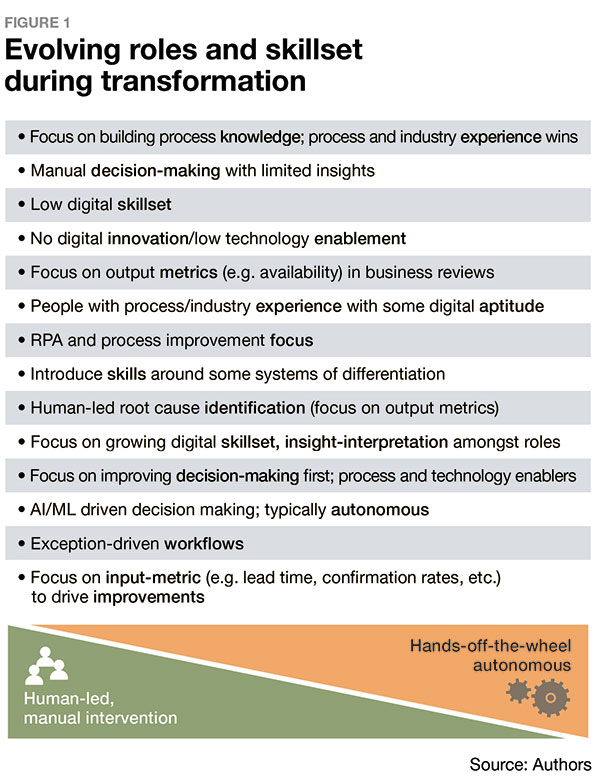
Supply chain digital transformations can fail due to a lack of recognition and investment in the evolving skillsets required to deliver and sustain such initiatives. The following table summarizes the changing role of individuals and functions as they evolve from a hands-on/manual intervention-led operation to a hands-off-the-wheel autonomous capability.
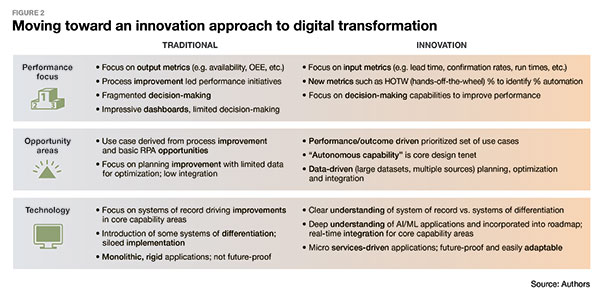
Apply a microservices technology strategy to create high-fidelity supply chains. Evolving from the traditional ERP-centric technology strategy to a microservices architecture is paramount to a next-gen supply chain strategy. While the ERP role remains critical as a system of record, microservices incorporate many new sources of internal and external data with agility to power AI and ML supply chains.
The table above illustrates examples of the difference in approach across each of the above areas, driving a more effective approach for your transformation journey.
Conclusion
Prior to COVID, supply chains were being reinvented as AI/ML provided step-change capabilities significantly beyond incumbent systems and operations. COVID accelerated and compounded the situation as structural changes were incorporated for duplicity and balancing supply chain risk.
The resulting paradigm shifts create a call to action to transform supply chains across all industries. The single most important topic executives ask us is: “How do we create/accelerate our digital supply chain journey?” From there, they need to know where to start. Because of the paradigm shifts, the traditional path of creating a top-down operational strategy through reengineering is ineffective. Incorporating key drivers for changing supply chains while operating the business and maintaining margins while in-flight is a daunting task.
Organizations are unable to follow traditional paths of operating model transformation because of the fragmentation of data and siloed processes across organizations, disjointed decision-making, complexities across networks with little or no visibility, the evolving nature of digital skillsets required to build next-generation supply chains, and the lack of decision-making at speed.
There is no single blueprint that universally transforms supply chains across unique industries, value chains and operating models, but there are universal pillars to help ensure success. The pillars allow organizations to rethink their approach to transformation and allow leaders to gain control over their journey to diligently plan and execute their vision.
In our experience, organizations adopting the three pillars described to define design tenets for transformation will lead the industry and differentiate their service offering whilst enabling sustainable growth.
About the authors
Ricardo Ernst is the Baratta Chair in Global Business Professor of Opetations and Global Logistics at Georgetown University. He can be reached at [email protected].
Michael Brown is the global supply chain lead at Microsoft. He can be reached at [email protected].
Mayank Sharma is vice president of supply chain at Capgemini. He can be reached at [email protected].
SC
MR


More Artificial Intelligence
- Innovators Netstock, Pickle Robot win NextGen Solution Provider awards
- The biggest barrier to AI in supply chains isn’t technology
- NextGen Supply Chain Conference unveils agenda focused on AI, execution and the future of leadership
- From fragmented negotiations to coordinated negotiation performance: an AI-enabled approach
- Beyond the hype: Building flexible and scalable supply chains in a VUCA world
- Managing human and AI teams across the supply chain
- More Artificial Intelligence
Latest Podcast
 Explore
Topics
Software & Technology News
- Innovators Netstock, Pickle Robot win NextGen Solution Provider awards
- The biggest barrier to AI in supply chains isn’t technology
- NextGen Supply Chain Conference unveils agenda focused on AI, execution and the future of leadership
- From fragmented negotiations to coordinated negotiation performance: an AI-enabled approach
- Beyond the hype: Building flexible and scalable supply chains in a VUCA world
- Managing human and AI teams across the supply chain
- More Software & Technology
Latest Software & Technology Resources
Subscribe

Supply Chain Management Review delivers the best industry content.

Editors’ Picks



