Sorry, but your login has failed. Please recheck your login information and resubmit. If your subscription has expired, renew here.
The rules of supply chain network design (SCND) have fundamentally shifted. In an era where volatility is the only constant, a supply chain modeled solely for stability is no longer an asset, it is a strategic liability.
While many organizations still treat disruption as a hurdle to clear, market leaders accept it as the baseline. They have moved beyond annual planning and reactive firefighting by redefining the design process itself. Today’s top performers have traded intermittent crisis management for continuous readiness. By integrating “what-if’ scenario modeling, these companies pressure-test decisions before disruption hits. Instead of relying on a static model optimized only for cost, they use a dynamic approach that identifies capacity tipping points in advance. When volatility strikes, these leaders do not scramble; they execute a predefined playbook while competitors are still diagnosing the problem.
SC
MR
Sorry, but your login has failed. Please recheck your login information and resubmit. If your subscription has expired, renew here.
The rules of supply chain network design (SCND) have fundamentally shifted. In an era where volatility is the only constant, a supply chain modeled solely for stability is no longer an asset, it is a strategic liability.
While many organizations still treat disruption as a hurdle to clear, market leaders accept it as the baseline. They have moved beyond annual planning and reactive firefighting by redefining the design process itself. Today’s top performers have traded intermittent crisis management for continuous readiness. By integrating “what-if’ scenario modeling, these companies pressure-test decisions before disruption hits. Instead of relying on a static model optimized only for cost, they use a dynamic approach that identifies capacity tipping points in advance. When volatility strikes, these leaders do not scramble; they execute a predefined playbook while competitors are still diagnosing the problem.
Survival now requires a fundamental mindset shift. We have to stop treating network design as a “set-and-forget” project and start treating it as a living capability. It is the difference between a static map and a real-time GPS. Table 1 outlines the strategic pivot required to move from a defensive posture to an offensive, always-ready advantage.
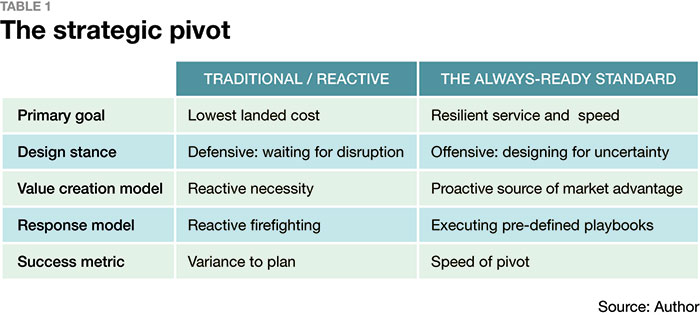
The mindset shift: From static planning to continuous design
The traditional “snapshot” model of network design assumes a world that stands still long enough for the plan to work. This creates a dangerous efficiency trap. When a network is designed for 2024 but operating in 2026, the model diverges from reality, creating a strategic blind spot where profit and customer trust quickly erode.
The new mindset requires a digital twin of the supply chain, a representative model of the physical network that provides the operational clarity needed to act with confidence. Unlike a static spreadsheet, this living model is fed by near-real-time data. It doesn’t just map warehouse locations, it accounts for shifting lead times, port congestion, and fluctuating fuel surcharges. This allows the network to be redesigned in increments, rather than through massive, disruptive overhauls every few years.
Additionally, the era of siloed spreadsheets is over. Traditional manual modeling in Excel is inherently fragile. For example, if the person who built the macro leaves, the knowledge often leaves with them. Continuous design uses centralized SCND software that provides cross-functional visibility. When finance, logistics, and procurement all look at the same “living model” of the supply chain, the conversation shifts from “whose data is right” to “which scenario is best for our business?”
In the old world, the goal was the destination: Get the product from A to B at the lowest cost. In the new world, the goal is the pivot. We must design for a low mean time to recover. This means building a network that has the inherent flexibility to reroute itself. If a primary node fails, the “continuous design” mindset ensures that the secondary and tertiary paths are already mapped, vetted, and ready for implementation.
The shift to an “always-ready” philosophy ultimately requires a revolution in internal incentives. Historically, companies have rewarded the “firefighter,” the manager who stays up 48 hours to fix a collapse. While heroic, this often masks a failure of planning. The new model rewards foresight, the manager who uses continuous digital stress testing to identify a bottleneck six months in advance, preventing the crisis entirely and driving sustained value. Table 2 outlines how “always-ready” organizations shift SCND from a periodic analytical exercise into an integrated operating capability.

The new economics of network design: Speed, resilience, and risk
The technical evolution of supply chain network design has moved beyond simplistic cost minimization. Historically, optimization models were deterministic, built on the fragile assumption of fixed variables, stable demand, consistent lead times, and predictable pricing and supply. In today’s reality, these assumptions are liabilities. Modern leaders have transitioned to stochastic modeling, which moves beyond single-point forecasts to provide a range of possible outcomes, preparing the network for the next crisis event.
You can’t optimize your way out of a broken strategy. A network optimized solely for the lowest landed cost is, by definition, brittle. In the pursuit of lean operations, many organizations inadvertently strip away the very buffers (excess capacity, safety stock, or supplier redundancy) that constitute resilience. Fragility is a hidden tax that most CFOs do not see until the bill comes due during a crisis. A model that appears 2% cheaper on a spreadsheet but possesses a 50% higher probability of failure during a global shipping crisis is the more expensive architecture.

To navigate this complexity, modern SCND utilizes multi-objective optimization to visualize the inherent friction between competing business drivers. As illustrated in Figure 1, every supply chain operates within a “triangle of trade-offs” where cash, cost and service exist in constant tension:
- Cash. The working capital anchored in inventory levels.
- Cost. The operational expenses across logistics, transportation, warehousing, and manufacturing.
- Service. The commitment to fill rates, speed, delivery transit time, and product portfolio breadth.
True strategic design is no longer about picking a single pillar and ignoring the others; it is about finding the “balance of priority.” By utilizing the “always-ready” mindset, executives can navigate the “efficient frontier” (the mathematical limit of what the network can achieve) and evaluate the “alternative balances.” Figure 1 transforms these from gut-feel guesses into quantified, visual strategic choices.
Strategic Insight: A company may intentionally move the dial toward service by increasing cash (inventory) to protect against anticipated volatility, or lean toward cost during periods of stability.
The “what-if” engine: Mitigating risk through simulation
The ultimate objective of the “always-ready” philosophy is to migrate the organization from a state of perpetual crisis management to one of proactive execution. This shift has never been more urgent as recent data indicate that supply chain disruptions continue to surge year after year. From the localized impact of factory fires and labor strikes to the systemic shocks of extreme weather and cyberattacks, the threats are both numerous and evolving. Given the current global landscape, your network model needs to function as a “what-if” engine, providing the protection you need to navigate constant change.
The power of this engine lies in its ability to simulate and solve for specific risk categories before they occur. For natural disasters and geopolitical instability, the model moves beyond the “single-source” trap by validating geographic diversification and redundancy. By mathematically testing “what-if” a primary shipping lane is blocked by conflict or a key manufacturing hub is leveled by a flood, the engine identifies the exact secondary facilities and alternative suppliers needed to maintain business continuity. This prevents the all-eggs-in-one-basket vulnerability, ensuring that when one region faces a localized shock, the network’s modular design allows for an immediate, seamless pivot to a stable alternative.
The ultimate objective of the “always-ready” philosophy is to move the organization from perpetual crisis management to proactive execution. When a year-over-year increase in chaos becomes the baseline, the firm does not call for a week of data discovery, it simply executes the script.
By identifying these tipping points in advance, leaders can pinpoint exactly when a 5% increase in volume will cause a specific distribution center to hit a threshold that collapses outbound service levels. This mathematical foresight allows for expansion and adjustment before the crisis manifests, turning capacity management from a reactive headache into a predictive advantage.
The “always-ready” imperative
In an era of constant change, the “always-ready” mandate is clear: supply chain design is no longer a static map, but a living strategy. Organizations that continue to view SCND as an occasional administrative task are building their houses on shifting sands.
By moving from a snapshot to a continuous, stochastic model, you are not just protecting your operations, you are building a more resilient foundation. This “always-ready” approach eliminates the paralysis of uncertainty and allows your team to lead with greater confidence. In the end, the goal isn’t just to survive the next disruption, but to use your network’s agility as a weapon to outperform, outpace, and outlast the competition, no matter what the market brings next. The question for leadership is no longer if your network will be tested, but whether the organization has already designed a response.
Next steps checklist
Transitioning to an always-ready posture doesn’t happen overnight. To begin your pivot from static planning to continuous design, prioritize these three foundational steps over the next 90 days.
Invest in a digital twin. Move beyond siloed spreadsheets. Invest in centralized SCND software that allows finance, logistics, and procurement to view a single, data-driven model of the physical network.
Stress-test tipping points. Identify the specific volume or lead-time thresholds that would cause your current distribution centers to fail. Document the pre-vetted alternate plans to activate the moment those thresholds are crossed.
Formalize the cadence. Replace 5-year “set and forget” cycles with quarterly “what-if” reviews to reconcile the model with current geopolitical and market realities.
About the author
Brad Barry is a partner & director at St. Onge Company, an engineering-driven consulting firm specializing in end-to-end supply chain transformation, S&OP, 3PL strategy, facility design, and healthcare systems and patient flow engineering. He can be reached at [email protected].
SC
MR


More Supply Chain Planning
- From orbit to operations: Winning the race for the earliest disruption signal
- Supply chain’s new normal isn’t stability, it’s change
- Leveraging advanced tech to develop next-level planning
- The always-ready supply chain: Turning disruption into competitive edge
- Beyond the forecast: Rethinking demand-driven planning
- More Supply Chain Planning
What's Related in Supply Chain Planning
 Explore
Topics
Business Management News
- PepsiCo moves its startup sustainability program from pilots to operational scale across Asia Pacific
- Eli Lilly’s Mar Gimeno to keynote at NextGen Supply Chain Conference 2026
- Agentic coding and the future of supply chain leadership
- From orbit to operations: Winning the race for the earliest disruption signal
- Stop moving boxes, start moving dollars: The new math of global supply chain velocity
- Finding your rhythm: SME supply chain footwork when the rules keep changing
- More Business Management
Latest Business Management Resources

Subscribe

Supply Chain Management Review delivers the best industry content.

Editors’ Picks