
Sorry, but your login has failed. Please recheck your login information and resubmit. If your subscription has expired, renew here.
May-June 2012
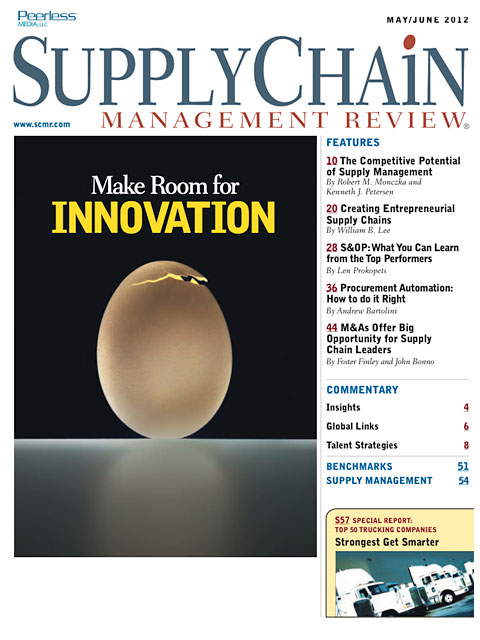
Supply management can be a powerful competitive weapon—if the strategy driving that activity is closely aligned with the business strategy. Yet new research suggests that the necessary alignment is often lacking. CAPS Research experts offer a process for identifying and implementing the supply management strategies that hold maximum potential for competitive advantage. Browse this issue archive.Need Help? Contact customer service 1-508-503-1313 More options
Over the past 15 years, many procurement departments have participated in a broad transformation of their function and gained greater awareness and relevance within the executive quarters. A large number of those procurement departments leveraged supply management technology to enable their transformation. Supply management solutions automate the sourcing, procurement, and accounts payable functions commonly referred to as the Source-to-Settle process. The primary applications that fall under this category are (1) spend analysis, which helps companies aggregate, classify, cleanse, and analyze their supplier spend information; (2) eSourcing, which automates the sourcing or bid process; (3) contract management, which automates the supplier contracting process; (4) eProcurement, which automates the requisition to purchase order process; and (5) ePayables, which automates the accounts payable process.
These solutions can drive efficiencies and savings and help organizations become more effective. (We’ve included two case study sidebars in this article that serve as examples.) In fact, when deployed successfully, these solutions can deliver some of the most compelling and competitive returns on an investment in enterprise technology available in the market. That means that these projects are absolutely worth undertaking.
Unfortunately, as with any IT project, the returns on these investments are far from guaranteed. There are many potential pitfalls and landmines that can pull a supply management automation project off of its course. The good news is that over the past 15 years, many, many groups have been successful. And these successes have helped establish standard industry best practices. In this article we highlight those best practices that can lead to a successful purchasing automation project. Our discussion follows this sequence: laying the groundwork for a successful automation project; managing the RFP process; and deploying the solution selected.
 |
This complete article is available to subscribers
only. Click on Log In Now at the top of this article for full access. Or, Start your PLUS+ subscription for instant access. |
Not ready to subscribe, but need this article?
Buy the complete article now. Only $20.00. Instant PDF Download.
Access the complete issue of Supply Chain Management Review magazine featuring
this article including every word, chart and table exactly as it appeared in the magazine.
SC
MR
Sorry, but your login has failed. Please recheck your login information and resubmit. If your subscription has expired, renew here.
May-June 2012
Supply management can be a powerful competitive weapon—if the strategy driving that activity is closely aligned with the business strategy. Yet new research suggests that the necessary alignment is often lacking.… Browse this issue archive. Download a PDF file of the May-June 2012 issue.|
|
Download Article PDF |
Over the past 15 years, many procurement departments have participated in a broad transformation of their function and gained greater awareness and relevance within the executive quarters. A large number of those procurement departments leveraged supply management technology to enable their transformation. Supply management solutions automate the sourcing, procurement, and accounts payable functions commonly referred to as the Source-to-Settle process. The primary applications that fall under this category are (1) spend analysis, which helps companies aggregate, classify, cleanse, and analyze their supplier spend information; (2) eSourcing, which automates the sourcing or bid process; (3) contract management, which automates the supplier contracting process; (4) eProcurement, which automates the requisition to purchase order process; and (5) ePayables, which automates the accounts payable process.
These solutions can drive efficiencies and savings and help organizations become more effective. (We’ve included two case study sidebars in this article that serve as examples.) In fact, when deployed successfully, these solutions can deliver some of the most compelling and competitive returns on an investment in enterprise technology available in the market. That means that these projects are absolutely worth undertaking.
Unfortunately, as with any IT project, the returns on these investments are far from guaranteed. There are many potential pitfalls and landmines that can pull a supply management automation project off of its course. The good news is that over the past 15 years, many, many groups have been successful. And these successes have helped establish standard industry best practices. In this article we highlight those best practices that can lead to a successful purchasing automation project. Our discussion follows this sequence: laying the groundwork for a successful automation project; managing the RFP process; and deploying the solution selected.
|
|
SUBSCRIBERS: Click here to download PDF of the full article. |
SC
MR

More Automation
- Innovators Netstock, Pickle Robot win NextGen Solution Provider awards
- NextGen Supply Chain Conference unveils agenda focused on AI, execution and the future of leadership
- Beyond the hype: Building flexible and scalable supply chains in a VUCA world
- Technology isn’t strategy
- What the INFORMS Analytics+ Conference revealed about the future of supply chain (and why you might be getting left behind)
- Wayfair executive to share lessons from building a tech-driven delivery network in NextGen Keynote
- More Automation
Latest Podcast
 Explore
Topics
Software & Technology News
- Innovators Netstock, Pickle Robot win NextGen Solution Provider awards
- The biggest barrier to AI in supply chains isn’t technology
- NextGen Supply Chain Conference unveils agenda focused on AI, execution and the future of leadership
- From fragmented negotiations to coordinated negotiation performance: an AI-enabled approach
- Beyond the hype: Building flexible and scalable supply chains in a VUCA world
- Managing human and AI teams across the supply chain
- More Software & Technology
Latest Software & Technology Resources
Subscribe

Supply Chain Management Review delivers the best industry content.

Editors’ Picks



