
In a new “manufacturing outlook” report focusing on the automotive and industrial sectors, AlixPartners observes that many of the labor-cost advantages associated with near-shoring may be lost if companies fail to spend more on automation in the future.
The consultancy notes that automation capabilities have improved dramatically, and implementation expenses have come down. As a consequence this kind of technology can help manufacturers augment—or entirely replace— functions previously performed entirely by humans.
“To exploit those technologies, manufacturers will likely have to make capital-intensive investments,” says Foster Finley, a managing director at AlixPartners in New York. “But they should understand, too, that automation cannot replace a human workforce.”
Instead, adds Finley, automation shifts the focus to a new set of critical skills.
“As automation technology becomes more available and more affordable, companies will have to adopt longer-term views on developing and retaining talent aligned with the tactical use of robotics,” he says.
The survey, which polled manufacturing and distribution companies in the U.S. and Western Europe, finds that 69% of respondents believe near shoring is a possible opportunity to meet demand from consumers, up from 40% in last year's survey.
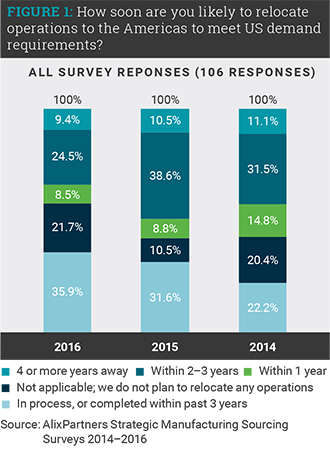
“This increase in near shoring has led to labor challenges, however,” says Finley. “Many respondents are having a hard time filling roles like product engineers and frontline supervisors.”
Along with these labor issues, two-thirds of respondents said they plan to invest significantly in automation technologies.
“So what we may expect is more spend in human resources with higher salaries and other incentives, at the same time companies will place greater reliance on technology.”
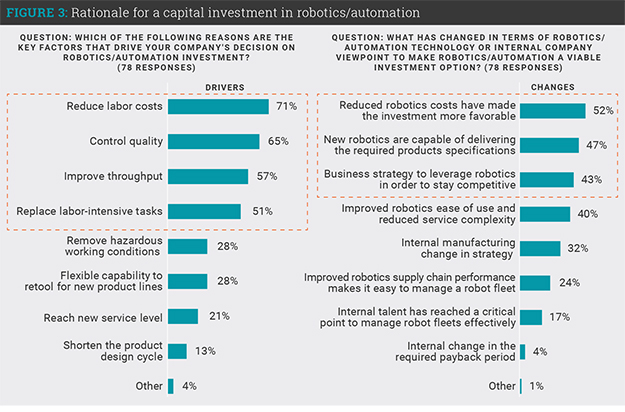
Researchers note that automotive and electronics manufacturers have been the biggest adopters of automation technology thus far. But companies in other sectors—such as pharmaceuticals, instrumentation and measurement devices, medical equipment, and pulp and paper— will likely begin to shift more of their manufacturing capacity to robots in the coming years.
Download the Report: Near Shoring Continues, Labor Becomes a Limiting Factor, and Automation Takes Root
SC
MR


More Automation
- NextGen Supply Chain Conference unveils agenda focused on AI, execution and the future of leadership
- Beyond the hype: Building flexible and scalable supply chains in a VUCA world
- Technology isn’t strategy
- What the INFORMS Analytics+ Conference revealed about the future of supply chain (and why you might be getting left behind)
- Wayfair executive to share lessons from building a tech-driven delivery network in NextGen Keynote
- The real reason supply chain tech ROI falls short
- More Automation
Latest Podcast
 Explore
Software & Technology News
- Innovators Netstock, Pickle Robot win NextGen Solution Provider awards
- The biggest barrier to AI in supply chains isn’t technology
- NextGen Supply Chain Conference unveils agenda focused on AI, execution and the future of leadership
- From fragmented negotiations to coordinated negotiation performance: an AI-enabled approach
- Beyond the hype: Building flexible and scalable supply chains in a VUCA world
- Managing human and AI teams across the supply chain
- More Software & Technology
Latest Software & Technology Resources
About the Author
Patrick Burnson, Executive Editor

Patrick is a widely-published writer and editor specializing in international trade, global logistics, and supply chain management. He is based in San Francisco, where he provides a Pacific Rim perspective on industry trends and forecasts. He may be reached at his downtown office: [email protected].
Follow SCMR on social media.
@SupplyChainManagementReview on Facebook
@SCMR on Twitter
SCMR on Linkedin
Subscribe

Supply Chain Management Review delivers the best industry content.

Editors’ Picks



