
Sorry, but your login has failed. Please recheck your login information and resubmit. If your subscription has expired, renew here.
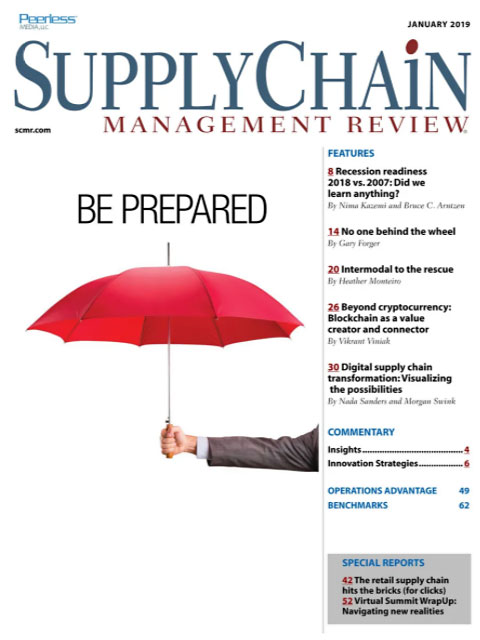
January-February 2019
Truth be told, I was not a Boy Scout, or at least not a very good scout and not for very long. But I think there are some lessons for supply chain managers in the Scout motto: Be prepared. When I Wiki’d it this morning, I found the following: Be prepared, which means you are always in a state of readiness in mind and body to do your duty. Browse this issue archive.Need Help? Contact customer service 1-508-503-1313 More options
It seems that no self-respecting company can be without a digital transformation (DT) strategy these days. But shifting an organization from an analog mindset to the brave new world of digitalization is a long and challenging journey. Where do you start, how do you prepare employees, and once there, how do you engender trust in digitalized processes?
These issues were explored from a retail industry perspective at a recent MIT CTL roundtable. The Future of Retailing roundtable took place on November 14-15 2018, and brought together supply chain practitioners from various organizations including manufacturers, retailers and third-party logistics providers.
The discussions did not yield any magic bullets—there aren’t any, of course—but they did produce a number of insights that can help companies tread easier as they quest toward a digitalized
supply chain future.
Getting started
Identifying a starting point in the journey is not easy, especially when companies are deluged with information and advice on how they should proceed. But rather than spending vast amounts of time considering possibilities and generating a lot of frustration, another approach is to opt for any project that gets you on your way and is likely to deliver some successes—even modest ones—that can be easily shared and engage the organization.
This might seem a little too serendipitous, but you can refine your search criteria to increase the chances of success. For example, choose an external supply chain partner that is motivated and needs your contribution, has experience and knowledge it is willing to impart, and is interested in a specific project that can be scaled and quantified. As the partnership develops, you can expand your horizons to other partners.

This complete article is available to subscribers only.
Log in now for full access or start your PLUS+ subscription for instant access.
SC
MR
Sorry, but your login has failed. Please recheck your login information and resubmit. If your subscription has expired, renew here.
January-February 2019
Truth be told, I was not a Boy Scout, or at least not a very good scout and not for very long. But I think there are some lessons for supply chain managers in the Scout motto: Be prepared. When I Wiki’d it this… Browse this issue archive. Access your online digital edition. Download a PDF file of the January-February 2019 issue.It seems that no self-respecting company can be without a digital transformation (DT) strategy these days. But shifting an organization from an analog mindset to the brave new world of digitalization is a long and challenging journey. Where do you start, how do you prepare employees, and once there, how do you engender trust in digitalized processes?
These issues were explored from a retail industry perspective at a recent MIT CTL roundtable. The Future of Retailing roundtable took place on November 14-15 2018, and brought together supply chain practitioners from various organizations including manufacturers, retailers and third-party logistics providers.
The discussions did not yield any magic bullets—there aren't any, of course—but they did produce a number of insights that can help companies tread easier as they quest toward a digitalized
supply chain future.
Getting started
Identifying a starting point in the journey is not easy, especially when companies are deluged with information and advice on how they should proceed. But rather than spending vast amounts of time considering possibilities and generating a lot of frustration, another approach is to opt for any project that gets you on your way and is likely to deliver some successes—even modest ones—that can be easily shared and engage the organization.
This might seem a little too serendipitous, but you can refine your search criteria to increase the chances of success. For example, choose an external supply chain partner that is motivated and needs your contribution, has experience and knowledge it is willing to impart, and is interested in a specific project that can be scaled and quantified. As the partnership develops, you can expand your horizons to other partners.
SUBSCRIBERS: Click here to download PDF of the full article.
SC
MR


Latest Supply Chain News
- Supply chain resilience isn’t a data problem; it’s a judgment problem
- Beyond the hype: Building flexible and scalable supply chains in a VUCA world
- Why your supply chain risk management plan will fail
- When component verification becomes operational
- Caught between a rock and a hard place: Mapping your supply chain
- More News
Latest Resources
 Explore
Topics
Software & Technology News
- NextGen Supply Chain Conference unveils agenda focused on AI, execution and the future of leadership
- From fragmented negotiations to coordinated negotiation performance: an AI-enabled approach
- Beyond the hype: Building flexible and scalable supply chains in a VUCA world
- Managing human and AI teams across the supply chain
- The AI-empowered supply chain leader
- Technology isn’t strategy
- More Software & Technology
Latest Software & Technology Resources

Subscribe

Supply Chain Management Review delivers the best industry content.

Editors’ Picks



