Sorry, but your login has failed. Please recheck your login information and resubmit. If your subscription has expired, renew here.
Consumer packaged goods (CPGs) companies lose millions of dollars annually to inefficient order management practices, with Kearney estimating these losses at $800 billion in lost top-line growth opportunities globally[¹]. One of the most visible symptoms of systemic failures in distribution network optimization can be traced back to circular transfers, which represent product movements that create loops in the distribution network (e.g., A→B→C→A), signifying inefficient routings that should have been eliminated through optimization.
To address this challenge, this article presents a comprehensive framework for implementing Dynamic Order Management and Deployment Optimization (DODO) systems that eliminate these inefficiencies while improving service levels and reducing costs. Drawing from extensive implementation experience across CPG networks and validated industry engagement by the first author (Om Prakash), we demonstrate how modern distributed order management systems can reduce circular transfers to near-zero levels, and achieve inventory reductions of 20% to 30%, all while maintaining service levels, and delivering annual savings ranging from $8 to $22 million depending on network complexity.
SC
MR
Sorry, but your login has failed. Please recheck your login information and resubmit. If your subscription has expired, renew here.
Authors’ note: The circular transfer patterns, examples, and implementation strategies presented in this article are based on the first author’s direct experience with CPG supply chain optimization projects and observations from real-world implementations.
Consumer packaged goods (CPGs) companies lose millions of dollars annually to inefficient order management practices, with Kearney estimating these losses at $800 billion in lost top-line growth opportunities globally[¹]. One of the most visible symptoms of systemic failures in distribution network optimization can be traced back to circular transfers, which represent product movements that create loops in the distribution network (e.g., A→B→C→A), signifying inefficient routings that should have been eliminated through optimization.
To address this challenge, this article presents a comprehensive framework for implementing Dynamic Order Management and Deployment Optimization (DODO) systems that eliminate these inefficiencies while improving service levels and reducing costs. Drawing from extensive implementation experience across CPG networks and validated industry engagement by the first author (Om Prakash), we demonstrate how modern distributed order management systems can reduce circular transfers to near-zero levels, and achieve inventory reductions of 20% to 30%, all while maintaining service levels, and delivering annual savings ranging from $8 to $22 million depending on network complexity. This substantial potential has also been highlighted by Gartner Research, which documented CPG manufacturers achieving annual inventory cost savings of $22 million and inventory reductions of 27% through supply chain optimization initiatives.[2,3] Yet, companies are still struggling to address this issue, with this article aiming to provide a first step to break the circular transfer loop. Our multi-phase implementation methodology described in this article progresses from rule-based optimization to machine learning-enabled autonomous decision-making, providing practitioners with a proven roadmap for transformation.
The multi-million-dollar inefficiency crisis
The CPG industry has been facing a distribution paradox that costs millions annually; specifically, while point-of-sale data provides unprecedented visibility into consumer demand patterns, and sophisticated forecasting algorithms predict future requirements with increasing accuracy, the critical middle layer—order routing and deployment optimization—remains surprisingly primitive in many organizations. As such, many CPG supply chains suffer inefficiencies from circular stock transfers where a default order is initially assigned to a local distribution center (DC). If stock is unavailable, the order is routed to another DC—or requires stock to be transferred between DCs—often resulting in orders looping through multiple facilities (e.g., A to B to C and back to A). This repetitive routing can drastically increase transportation and fulfillment costs as well as delay order fulfillment.
Principles founded in the bullwhip effect suggest that the demand variability and stock transfer errors amplify as they move upstream in the supply chain[4], with such demand variability manifesting one of its most visible effects in what we term “circular transfers”—products moving through patterns such as A→B→C→A before ultimately reaching customers. When DCs make decisions in isolation without visibility into network-wide inventory positions and downstream transfer requirements, they create a cycle of inefficient movements.
Consider a typical scenario: A major food manufacturer receives a customer order for frozen vegetables to be delivered to Miami. The order was initially assigned to distribution center A (Atlanta), which is the default fulfillment location based on proximity. However, DC-A has insufficient frozen inventory to fulfill the order. The system routes the order to DC-B (Jacksonville, Florida), which has adequate frozen inventory and is closer to the Miami customer. Jacksonville accepts the order but discovers it needs to replenish its own stock to maintain service levels for its upcoming orders. DC-B requests an inventory transfer from DC-C (Birmingham, Alabama), which has surplus frozen inventory. Birmingham approves the transfer request and begins preparing the shipment. However, to replenish its own inventory after fulfilling Jacksonville’s request, DC-C places a stock transfer order back to its regional hub—which happens to be DC-A (Atlanta). (See Figure 1.)

Research from BCG and the Grocery Manufacturers Association reveals that CPG companies carry 60% of total logistics costs and hold roughly 50% of inventory burden[5]. According to these sources, the industry spends approximately $15.5 billion annually on transportation alone, which has up to a 5 percentage point impact on the bottom line[5]. Out of this annual logistics spending, unnecessary product movements between distribution centers consume an estimated 8% to 12%, which is equivalent to $1.2 to $2 billion in aggregate annual waste.
These circular patterns are systematic failures arising from three fundamental gaps in traditional order management approaches, such as the following.
- Temporal myopia: Systems generally optimize for immediate order fulfillment without considering downstream impacts on network balance. McKinsey research shows that associated AI-enhanced forecasting can reduce these myopic decisions by 30% to 50%[6].
- Siloed decision-making: As frequently observed in practice via our interactions with industry, order routing, inventory deployment, and transportation planning frequently operate independently, with siloed decision-makers aiming to complete their tasks so that they are “off their to-do list” without considering implications across the supply chain network ecosystem.
- Static rules in dynamic environments: Fixed allocation rules that cannot adapt dynamically to constantly shifting and unpredictable omnichannel demand patterns.
However, against these realities, a new paradigm is emerging: Based on the experiences of the first author, leading CPG companies implementing sophisticated Dynamic Order Management systems are breaking free from this circular transfer trap, achieving remarkable performance improvements, leading to an estimated 20% to 30% inventory reduction while maintaining service levels, coupled with an estimated 5% to 10% reduction in total supply chain costs, and 30% to 40% reduction in redeployment or circular transfers. Prior to outlining how this can be achieved, let’s look at the anatomy of circular transfer inefficiency.
The anatomy of circular transfer inefficiencies
Understanding the mechanics of circular transfers (see Figure 2) is essential for developing effective countermeasures. Our research and interactions with a range of CPG companies revealed five primary patterns of circular transfer behaviors, each with its distinct root causes and optimization approaches. While several of the inefficiencies described seem obvious and easy to fix, reality suggests that these occur more than expected, with the inefficiencies amounting to substantial costs for supply chains.

Type 1: Reactive scramble loops
Movement pattern: DC- A→ DC-B→ DC-C→ DC-A, within 48 to 72 hours due to stockout at one DC.
Root cause: Panic responses to unexpected stockouts and lack of system visibility.
Example: A Thursday afternoon stockout at distribution center A triggers expedited inventory pulls from distribution center B, which approves the request due to a lack of complete visibility into its own outstanding orders. That triggers distribution center B to request stock transfers the next day from distribution center C. These unnecessary movements could have been avoided if distribution center A had requested a resupply from distribution center C.
Type 2: Forecast whiplash (reversal) cycles
Movement pattern: Gradual. DC-A → DC-B → DC-C → DC-D → DC-A, more than 10-14 days.
Root cause: Forecast adjustments that create artificial demand signals.
Example: Marketing announces a promotional event for organic pasta, forecasting 300% demand increase. In response, DC-A requests large transfers of this pasta from DC-B to prepare for the surge. Subsequently, DC-B, now showing a projected shortfall, pulls inventory from DC-C. The promotion underperforms (only 120% increase in demand vs. 300% forecasted), leaving DC-A with excess stock. Meanwhile, DC-C faces unexpected demand and requests transfers from DC-D, which then needs to be rebalanced from the closest surplus location—DC-A. The result: products circle through DC-A→ DC-B→ DC-C→ DC-D→ back to DC-A over 10-14 days, driven by forecast errors rather than actual customer demand, increasing network inventory by 15% to 20% and transportation costs by 25% to 35%.
Type 3: Capacity overflow spirals
Movement pattern: DC- B/C/D → DC-A → DC- B/C/D. Hub-and-spoke patterns during peak periods. i.e. goods flow from many spoke locations to a central hub (for consolidation/sorting or storage for a short time) and then back to those spokes.
Root cause: Storage and/or capability constraints forcing temporary relocations.
Example: Seasonal peak overwhelms a primary DC with larger demand than anticipated, triggering overflow movements to other distribution centers. For instance, during Thanksgiving peak, DC-B, DC-C, and DC-D send frozen turkey products to DC-A (the central hub of the network) for specialized holiday packaging using automated equipment available only at DC-A, and then delivering them to customers from DC-A itself. However, DC-A’s storage capacity becomes overwhelmed with simultaneous incoming volume from multiple spokes. And therefore, after completing the packaging, instead of shipping directly to customer, DC-A had to immediately send the finished products back to DC-B, DC-C, and DC-D for final distribution to customers.
Type 4: Temperature zone shuffles
Movement pattern: DC-A→ DC-B→ DC-A. Products moving between temperature-compatible facilities
Root cause: Inadequate multi-temperature planning (insufficient multi-temperature or cross-zone capacity and lane qualification across frozen/chilled/ambient areas).
Example: A frozen food manufacturer’s Memphis distribution center receives an order for ice cream destined for Phoenix. The Memphis DC has frozen storage capacity but discovers its Phoenix-bound refrigerated truck is at capacity. The system routes the ice cream through the Dallas DC (multi-temperature capable) on a temperature-controlled trailer to an Albuquerque, New Mexico, DC for consolidation, and finally to Phoenix—creating two unnecessary temperature transitions and extending delivery by three to four days, all due to the refrigerated/frozen freight capacity being constrained on the optimal route.
Type 5: Compliance chase patterns
Movement pattern: DC- A/B/C→ DC-M → DC-L → A/B/C. Products move due to regulatory and/or compliance-related requirements or sometimes due to customer-specific demands or agreements. For example: a customer requires delivery of organic products only from organic-certified DCs.
Root cause: Regulatory and/or customer-specific requirements/constraints, coupled with a lack of visibility.
Example: A major organic food distributor receives an order for organic quinoa. While DC-B is geographically closest and has sufficient stock, the retailer requires shipment from USDA-certified organic facilities. DC-B lacks organic certification, so the system routes the order to certified DC-A, which is short on inventory and therefore requests a transfer from the main organic hub, DC-C. Ironically, DC-C had previously transferred this same quinoa batch to DC-B for regional distribution before the certification requirement was known. While the organic property is voided as the product moves through a non-certified facility, this was done to preserve the freshness of the produce and avoid spoilage.
Result: Products travel the route DC-C→ DC-B→ DC-A→ end customer, instead of the optimal route DC-B→ end customer.
Another example would be if a customer requires a batch CoA (certificate of analysis: a document certifying product quality and testing results) and bilingual labels, requiring the lot leaving the primary DC for a QA (quality assurance)-release site where the customer-specified requirements can be checked, then to a labeling center, and then back into the shipping queue at the original DC.
The amplification effect: How small errors cascade
Circular transfers, such as the ones described above, rarely occur in isolation. As such, initial routing inefficiencies can trigger cascading effects throughout distribution networks, which have been described as “amplification or bullwhip effects.” These effects can be characterized as follows.
Immediate impact: Poor initial routing decisions due to limited visibility can result in expedited shipping requirements, increased labor costs, and reduced carrier availability (as capacity becomes constrained). Optimization systems can address this by processing millions of order combinations in real-time, reducing the cascading effects.
Short-term consequences: Safety stock triggers activate in response to perceived shortages, leading adjacent distribution centers to experience increased demand volatility as a short-term consequence. To respond to these dynamics, transportation planners tend to shift to spot market procurement to meet the urgent requirements, typically at premium rates.
Longer-term network effects: Sustained circular transfer patterns invoked by the above dynamics can degrade overall network service levels, generating persistent inventory imbalances, necessitating ongoing corrections, and eventually leading to customer satisfaction issues that require manual intervention (further exacerbating the issues) and necessitating relationship management.
To avoid falling victim to these amplification effects and suffering the consequences, we propose a framework that was implemented at a major CPG company. This framework can serve as a template for others to adapt and emulate.
The DODO framework: Dynamic Order and Deployment Optimization
The CPG company started addressing the above mentioned inefficiencies by optimizing the order allocation processes so orders are assigned to the appropriate DC from the outset based on dynamic, real-time inventory information, demand forecasts, and transfer costs, rather than fixed default locations. Additionally, when a DC-to-DC stock transfer is necessary, an intelligent optimization process was implemented to select the most appropriate DC while minimizing the risk of circular movements, ultimately lowering logistics costs and improving order fulfillment efficiency. These principles were considered when designing the Dynamic Order and Deployment Optimization (DODO) framework.
The DODO framework represents a shift from sequential, rule-based order processing to concurrent, intelligence-driven decision-making. In doing so, the framework combines five integrated decision layers (see Figure 3) or approaches that work synergistically to eliminate circular transfers while optimizing overall network performance.
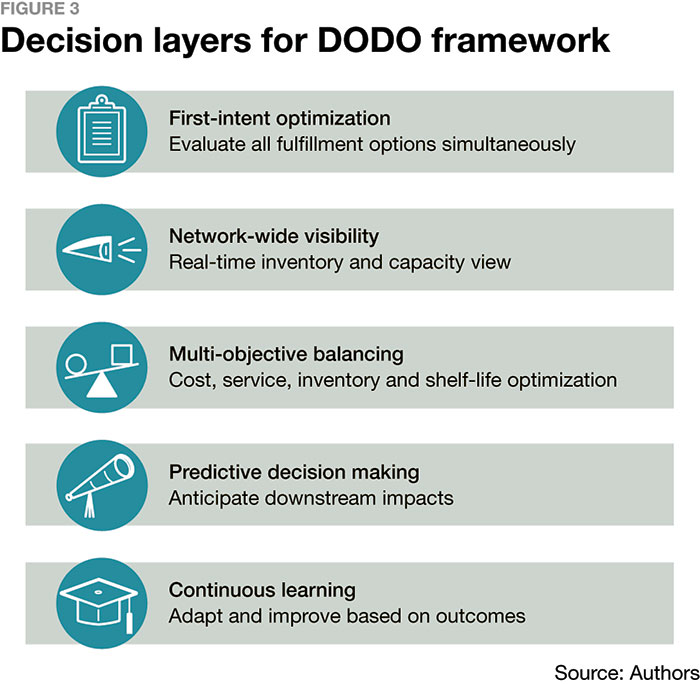
1. First-intent optimization: Commence every order routing decision with the consideration of all feasible fulfillment options simultaneously, ultimately selecting the option that optimizes across multiple objectives, rather than defaulting to simple rules or easy fixes like proximity, availability or how it has always been done.
This can be accomplished by implementing an optimization mechanism that simultaneously evaluates multiple available fulfillment options per order (e.g., all DCs within a pre-determined maximum service range) using a scoring algorithm that weighs cost, distance, inventory availability, and capacity constraints. Here, sequential if-then rules can be replaced with parallel evaluation conditions where all options are scored simultaneously. For instance, when an order arrives, instead of simply routing it to the closest DC, the optimization engine simultaneously evaluates all DCs within a 500-mile radius, scoring each option based on weighted criteria: transportation cost (30%), inventory availability (25%), capacity utilization (20%), handling cost (15%), and circular transfer risk (10%).
2. Networkwide visibility: Provide real-time visibility into inventory, capacity, and performance data across all fulfillment locations for informed networkwide decision-making rather than siloed optimization within individual facilities.
The needed network-based visibility is achieved by integrating real-time data feeds from warehouse management systems (WMS), transportation management systems (TMS), and enterprise resource planning (ERP) systems into a centralized data lake or dashboard. As part of this integration, inventory positions are updated continuously or in a predefined time frame rather than end-of-day batches. API connections can be implemented between all DCs to provide further integration and connectivity with the objective to share capacity utilization, order backlogs, and inbound shipment data. These API connections allow systems to talk to each other automatically and exchange information in real-time.
3. Multi-objective balancing: Systems simultaneously optimize for cost minimization, service maximization, inventory utilization, and shelf-life preservation rather than prioritizing single objectives.
This can be done by defining weighted objective functions where each goal (cost, service, inventory, shelf-life) receives a priority score (e.g., cost=30%, service=40%, inventory=20%, shelf-life=10%). Subsequently, multi-criteria decision analysis (MCDA) or mixed-integer linear programming (MILP) finds the solution that maximizes the weighted sum across all objectives rather than optimizing for cost alone.
4. Predictive decision-making: Machine learning algorithms anticipate downstream effects of order transfer and routing decisions, preventing moves that would likely require subsequent correction transfers.
To accomplish this, machine learning models (e.g., Random Forest, XGBoost) can be trained on 12 to 18 months of historical order data to identify patterns that precede circular transfers. The model can then predict probability scores (0% to 100%) that a routing decision will trigger downstream correction movements. Routing or stock transfer decisions with high circular-transfer probability (>70%) can then be blocked or flagged for manual review.
5. Continuous learning: ML/AI algorithms capture performance outcomes from every fulfillment decision, continuously improving stock transfer recommendations and routing logics based on actual results rather than static assumptions. This can be achieved by implementing feedback loops where the optimization engine captures final outcome data from every recommendation (accept or reject decisions by users, actual cost, delivery time, quality issues, subsequent transfers). This data is fed back into the ML models to retrain algorithms. At the same time, model accuracy metrics are tracked (acceptance, precision, recall) and automatically adjusts the logic based on performance trends.
Mathematical formulation
The five core capabilities/approaches described above provide the conceptual foundation for the DODO framework, which can be operationalized into real-time order-routing decisions via linear programming (LP)— a mathematical optimization technique that finds the best solution from a set of feasible options while satisfying defined constraints.
For example, in the DODO context, LP can answer the question: “Given the current network conditions, which fulfillment path(s) minimize(s) total system cost while meeting all service requirements?”
In doing so, the DODO optimization model solves a multi-objective problem balancing service, cost, and network stability. An example of the mathematical model is as follows.
Objective function: Minimize: Z = α1C_transport + α2C_handling + α3C_inventory + α4P_service + α5R_stability.
Where:
- C_transport = Transportation costs, including line-haul and last-mile delivery
- C_handling = DC handling and processing costs
- C_inventory = Carrying costs and obsolescence risk
- P_service = Penalties for service level violations
- R_stability = Network stability regularization term
- α_i = Weight parameters calibrated to business priorities
Subject to constraints/requirements, such as:
- demand satisfaction/service levels;
- inventory availability for x days for default orders;
- capacity limitations;
- anti-circular constraints;
- dock, labor, handling equipment, and/or specialized capacity (e.g., cold storage) availability;
- as well as any other factors that constrain the system or are imposed by the environment (e.g., regulations, disruptions etc.).
The AI advantage: How machine learning can power DODO
The DODO framework can significantly benefit from artificial intelligence and machine learning to transform order routing from reactive to predictive. What follows is how AI can enable each core capability.
Predictive decision-making: Machine learning models can analyze historical order data to predict which routing decisions may trigger downstream circular transfers.
Continuous learning: Advanced AI/ML systems can capture outcomes from every order (including actual cost, delivery time, and quality issues) and use this data to retrain algorithms periodically, enabling continuous improvement over time.
Real-time optimization: AI-powered platforms can process millions of order combinations simultaneously, evaluating all feasible DC options in a matter of seconds per order. According to McKinsey research, AI-driven forecasting can reduce errors by 20% to 50%, which translates into up to 65% reduction in lost sales and product unavailability[7].
Potential implementation timeline:
- Shadow mode (months 1-2): AI recommendations could run parallel to existing systems for validation.
- Hybrid mode (months 3-4): Organizations may set confidence thresholds for auto-approval.
- Autonomous mode (months 5+): Manual review might be reserved only for edge cases.
Potential outcomes: Organizations implementing AI-enhanced forecasting systems can expect significant reductions in forecasting errors and improvements in product availability and service levels.
An illustrative multi-phase implementation strategy
To implement the DODO framework, a multi-phase implementation approach (see Figure 4) can be pursued, with the objective to balance speed-to-value with risk management, enabling organizations to build confidence and capability progressively.
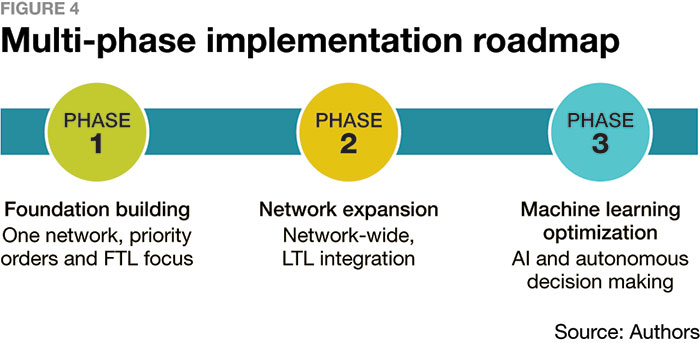
Phase 1: Foundation building: One network, priority orders, and FTL focus
The foundation phase establishes core infrastructure while demonstrating immediate value through targeted pilot implementations focusing only on one network at a time, priority orders, full truckload (FTL) shipments, and/or high-volume lanes.
This focused scope maximizes early ROI, provides a proof of concept while minimizing complexity, and garners organizational buy-in. As such, it is suggested to focus in this first phase on priority orders (typically the top 20% by volume or spend) that represent a large chunk of the total transportation spend, meaning even modest efficiency gains deliver substantial cost savings that justify continued investment. In addition, FTL shipments are strategically simpler than less-than-truckload (LTL) shipments as each order fills one truck with a single origin and destination, eliminating the complexity of consolidation, route optimization across multiple stops, and carrier coordination. Together, these constraints create a simpler context, allowing the team to demonstrate the DODO framework’s value on the most impactful portion of the business and build expertise on well-understood routes before tackling the complexity of multi-stop LTL consolidation, split shipments, and lower-volume lanes. The following represents an illustrative target scope.
Suggested scope definition:
- Top 20% of SKUs by volume or spend, representing major revenue lanes.
- 2-3 primary distribution centers (hubs) for pilot implementation.
- Only FTL shipments to minimize transportation and coordination complexity.
- A single temperature zone to avoid cold chain optimization challenges.
Key outcomes:
- Default DC identification.
- Order divert or transfer recommendations.
- Operational rulebook with encoded anti-circular logic.
- Performance baseline documentation showing current circular transfer costs, illustrating the savings potential.
- Quick-win demonstrations typically achieve a 10% to 15% improvement in order fulfillment efficiency.
- Real-time inventory visibility across pilot locations.
Illustrative success metrics to look for:
- Circular transfer reduction: 20% to 25%.
- Order cycle time improvement: 15% to 20%.
- Route guide compliance: >90%.
- System adoption rate: >80%.
Illustrative example of an operational rulebook with anti-circular logic:
a. Pre-transfer eligibility gate (must pass all):
- Demand screen (to ensure in-house demand): Receiving DC must have its own default orders plus the next 10-day forecast.
- Capacity screen (to ensure capacity availability): Dock availability and labor hours should be checked to ensure they are able to receive, put away, and pick within SLA and other requirements (e.g., work schedules).
- Service screen (to ensure service promises): Estimated time of arrival + putaway + pick/pack ≤ RDD (requested delivery date) – any buffer time, so that all affected orders keep their RDD. If any fail, block transfer.
b. No-return window: Any pallet moved A → B cannot return to A (or the prior node) for 14 days, unless moving back prevents a service breach (>X% OTIF risk).
c. Maximum inter-DC movement cap ≤ m DC→DC moves per pallet, where ‘m’ can be any desired number; For example: a (x+1)th move auto-blocks and triggers planner review.
d. Source-of-truth rule: If origin DC can ship within T days at cost ≤ Y versus redeploy, then reject the proposal, and redeploy and fulfill from origin.
e. Loop breaker: After A→B then B→C, prohibit C→A/C→B unless new demand within R miles of destination or service range justifies it.
f. Aging priority: When DOH (inventory days on hand) at any node exceeds Z, redeployment must pull oldest lots first.
Phase 2: Network expansion and LTL integration
The expansion phase implements more sophisticated order routings across broader product portfolios, networks and orders,
and introduces LTL optimization with FTL conversion analysis. Here are some illustrative capability enhancements and ideas for order smoothing to avoid excessive swings over
the planning horizon.
Illustrative capability enhancements:
- Multi-objective optimization balancing cost, service, and inventory considerations.
- LTL to FTL conversion algorithms analyzing consolidation opportunities.
- Order splitting optimization possibilities enabling dynamic sourcing from multiple DCs.
- Real-time carrier selection incorporating dynamic pricing and capacity availability.
Order smoothing implementation:
- Sequential next 10 days (T+10) demand forecasting integration for proactive inventory positioning. Stock transfers should be triggered to a DC only when it has the capacity for fulfilling its own default orders for the next 10 days.
- Implement a rolling 10-day planning horizon enabling anticipatory stock movements.
- Deploy smoothing algorithms reducing demand volatility by 15% to 25%.
- Ensure buffer stock optimization based on smoothed demand patterns.
Illustrative success metrics to look for:
Enhanced order divert/transfer recommendations to reduce redeployments. The model will check the order fulfillment from the available inventory at default DC first. If there is no sufficient inventory at default DC then it would recommend the order transfer to the most suitable DC by checking all the constraints and rules so that it can eliminate or reduce redeployment or multiple transfers. Typical achievements after this phase should be the following:
- Circular transfer reduction: 35% to 40%.
- Inventory turns improvement: 20% to 25%.
- Perfect order fulfillment: >90%.
- LTL to FTL conversion rate: 15% to 20% of eligible orders.
Phase 3: Machine learning and autonomous optimization
The automation phase introduces artificial intelligence for autonomous decision-making, including learning from implemented recommendation acceptance/rejection patterns.
Illustrative machine learning implementation:
- Recommendation engine: AI algorithms generate DC-to-DC transfer recommendations with confidence scores.
- The algorithms further analyze historical transfer data, real-time inventory levels, order urgency, and transportation costs to propose optimal DC-to-DC transfers. For each recommendation, the engine generates a confidence score reflecting how well the proposed move is expected to meet fill rate, cost, and delivery objectives.
- Rejection analysis: The system learns from user rejection patterns (i.e., in all of this, the systems do not operate autonomously, but rather provide derived recommendations to the user, who can then accept, modify or reject the recommended course of action), frequency and contexts, with the objective to improve future recommendations.
- Reason code learning: Machine learning models incorporate specific rejection reasons (capacity constraints, transportation costs, service priorities) to refine recommendation logic.
- Adaptive optimization: Algorithms continuously adjust the framework based on actual performance outcomes. By tracking KPIs (fill rate, on-time delivery, cost-to-serve, and order-to-delivery lead time), the system autonomously learns which transfers drive optimal results.
Advanced capabilities:
Once the foundation has been laid, advanced capabilities can be built on top with the objective to achieve some of the following:
- Autonomous circular transfer prevention with 95%+ detection accuracy.
- Self-correcting recommendation algorithms improving acceptance rates from an estimated 60% to 85%+.
- Predictive analytics for proactive disruption management.
- Dynamic safety stock adjustment based on demand sensing.
Illustrative success metrics to look for:
- Circular transfer elimination: >95%.
- Recommendation acceptance rate: >85%.
- Autonomous decision rate: >80%.
- Cost reduction: 25% to 30%.
Temperature zone optimization: Managing multi-zone complexity
CPG companies operating across multiple temperature zones face unique optimization challenges that traditional order management systems handle inadequately. The inherent complexity stems from hard constraints when products requiring different temperature ranges cannot share transportation or warehousing infrastructure.
Zone classification:
Common temperature zone classifications include the following:
- Deep frozen (-10 deg. F to -20 deg. F): Ice cream, frozen novelties.
- Standard frozen (0 deg. F to -10 deg. F): Frozen vegetables, prepared meals.
- Refrigerated or chilled (33 deg. F to 41 deg. F): Dairy, fresh meat, produce.
- Controlled ambient (55 deg. F to 75 deg. F): Chocolate, pharmaceuticals.
The suggested DODO framework could be expanded to also address cross-zone complexity with the following illustrative models.
Model 1: Zone-dedicated networks
By assigning dedicated DCs and resources to specific temperature zones, each order is managed and fulfilled within its designated region when possible. This reduces the need to route an order across multiple DCs or for inventory to be transferred back to meet demand in neighboring zones.
Advantages: Simplified operations, optimized equipment utilization.
Expected ROI: 15% to 20% improvement in zone-specific efficiency.
Best for: companies with high volume in specific zones.
Model 2: Multi-temperature facilities
Operating multi-temperature facilities enables companies to consolidate product storage and shipments for diverse product lines (e.g., refrigerated, frozen, ambient) within a single DC. This integration reduces the need to transfer orders or inventory between different temperature-dedicated DCs, a common source of circular transfers when availability mismatches occur.
Advantages: Shared overhead costs, consolidated shipments.
Expected ROI: 20% to 30% reduction in facility costs.
Best for: Diverse product portfolios with balanced volumes.
Both models or strategies target the root causes of circular transfers—inventory imbalance, siloed facilities, and unpredictable demand—by centralizing resources and aligning operations to local demand and product needs, thus minimizing unnecessary cross-DC order movements.
Strategic recommendations for implementation
Successful implementation of the DODO framework requires a strategic approach that considers the framework as a comprehensive business transformation rather than merely a technology upgrade. Organizations that combine executive commitment, cross-functional collaboration, and willingness to upgrade existing practices achieve the most substantial results in reducing circular transfers and optimizing inventory positioning. The following recommendations provide a structured pathway for organizations to progress from foundational capabilities to autonomous decision-making.
Immediate actions (0-6 months)
Supply chain assessment:
- Map current order flows and identify circular transfer patterns.
- Quantify financial impact using comprehensive cost modelling.
- Establish baseline performance metrics across service, cost, and efficiency.
- Identify high-impact pilot opportunities with manageable complexity.
Foundation building:
- Establish a data governance framework (policies or standard processes to validate and ensure data accuracy and consistency) for master data quality.
- Create a cross-functional steering committee with executive sponsorship.
- Select technology partners with proven CPG implementation experience.
- Design a pilot program focusing on FTL movements and high-volume lanes.
Medium-term initiatives (6-18 months)
System implementation:
- Deploy a dynamic order management (DOM) platform with basic optimization capabilities.
- Implement order smoothing for a “next 10 days” (T+10) planning horizon.
- Integrate LTL optimization with FTL conversion analysis.
- Establish performance dashboards for continuous monitoring.
Organizational development:
- Develop analytical capabilities through training and hiring.
- Create recommendation acceptance/rejection workflows.
- Implement a change management program for user adoption.
- Establish continuous improvement processes.
Long-term transformation (18+ months)
Advanced capabilities:
- Deploy machine learning for advanced recommendation optimization.
- Implement autonomous decision-making for routine transfers.
- Develop predictive analytics for disruption management.
- Create self-healing network capabilities.
A manager’s guide: How to do implemention
For non-technical managers, implementing DODO may seem daunting. Here’s practical guidance.
When to partner vs. build.
- Partner with IT if you have existing WMS/TMS systems that need integration.
- Hire consultants for algorithm development and ML model training.
- Consider third-party platforms such as SAP, Blue Yonder, o9 Solutions etc. to offer DODO-capable systems.
Vendor (platform) selection criteria.
- Real-time inventory visibility across all DCs (30–60 minutes data refresh). (Refresh time can vary based on specific project requirement.)
- Multi-objective optimization engine (not just cost minimization).
- Automated system connectivity to existing ERP/WMS.
- Pilot program offerings to test before full deployment.
Resource requirements by phase (can vary project to project).
- Phase 1 (3-4 months): 1 project manager, 2 analysts, IT support (20% time).
- Phase 2 (4-6 months): Add 1 data scientist, expand IT to 40% time.
- Phase 3 (6+ months): Add ML engineer for autonomous optimization.
Change management essentials.
- Train DC managers on new optimization and routing logic (2-day workshops).
- Create clear override protocols (when to trust AI vs. manual judgment).
- Establish feedback loops (capture why humans reject AI recommendations).
Quick ROI assessment (can vary project to project).
- Identify top 20% to 30% of orders by volume.
- Calculate current circular transfer costs (transportation + handling).
- Target 20% cost reduction within first 6 months.
- Typical payback period: 12 months to 18 months.
Key success factor: Start small with a focused pilot, prove value with measurable results, then scale systematically.
The next frontier: DODO integration and future directions
The DODO framework represents a foundational approach to eliminating circular transfers, which was implemented by the first author at a major CPG company, and was presented in this article to provide inspiration, motivation, and guidance for companies to implement. The effectiveness of the framework can be further enhanced through integration with complementary optimization techniques and emerging technologies, such as the following.
Multi-echelon inventory optimization (MEIO). Future enhancements should consider the synergistic potential of combining DODO with multi-echelon inventory optimization models that dynamically adjust safety stock positioning across the network. Research by Graves & Willems, for instance, demonstrates that MEIO can reduce total inventory by 30% to 50% while maintaining service levels[8].
Sales & operations planning integration. Integration with sales & operations planning internally and integrated business planning processes across the supply chain can provide strategic alignment between demand forecasting, capacity planning, and deployment optimization decisions.
Advanced demand sensing. Advanced demand sensing technologies utilizing machine learning algorithms can enhance the initial T+10 order smoothing capabilities by incorporating external signals such as weather patterns, social media trends, and economic indicators.
Network design optimization. Network design optimization techniques can complement DODO by periodically reassessing optimal facility locations, capacity allocations, and service territories based on evolving demand patterns and circular transfer elimination results.
Some illustrative emerging technologies for integration.
- Digital twin technology: For scenario simulation and what-if analysis.
- Internet of things (IoT): For real-time inventory and transportation visibility.
- Blockchain platforms: For multi-party supply chain coordination.
- Quantum computing: For solving large-scale DODO optimization problems.
Conclusion: The imperative for action
With increasing competitive pressures and heightened environmental uncertainties and complexities, the CPG industry stands at a critical inflection point. Companies that master dynamic order and deployment optimization will achieve sustainable competitive advantages through superior service, lower costs, and greater agility. Those that persist with traditional approaches face escalating inefficiencies, eroding margins, and deteriorating customer relationships.
The benefits associated with implementing DODO, which in a recent case were as much as a 30% to 40% reduction in circular transfers, 95%+ route guide compliance, and millions in annual cost savings, provide compelling justification for implementation. The multi-phase implementation methodology described herein offers a feasible path forward, balancing rapid value delivery with risk mitigation. The technical challenges are surmountable with modern cloud platforms, optimization algorithms, and machine learning capabilities. The greater challenge lies in organizational transformation—aligning and training stakeholders, obtaining buy-in, developing capabilities, and sustaining change momentum.
Every day of delay means millions in unnecessary costs, dissatisfied customers, low order fill rates, and competitive disadvantage, resulting in lost sales. The time for action is now. Companies willing to undertake this transformation will not only solve today’s inefficiencies but build platforms for sustained competitive advantage in tomorrow’s market. The circular transfer trap that poses a threat to productivity and efficiency of the CPG industry represents a great challenge and at the same time a great opportunity for supply chain leaders. The presented DODO (Dynamic Order and Deployment Optimization) framework provides the roadmap for escape and the foundation for building supply chains worthy of the world’s most demanding consumer markets.
References
- Kearney, A.T. (2024). “Inefficient supply chains will cost CPGs $800 billion in top-line growth.” Kearney Supply Chain Report. https://www.kearney.com/industry/consumer-retail/article/more-than-half-of-all-cpg-companies-on-track-to-grow-below-the-market-by-2027?utm_source=chatgpt.com
- Gartner (2024). “Supply Chain Technology Optimization Case Studies.” Gartner Supply Chain Insights. https://www.gartner.com/en/supply-chain
- Gartner (2024). “S&OP and Inventory Management Transformation Case Study.” Gartner Supply Chain Customer Success Stories. https://www.gartner.com/en/supply-chain/customer-success-stories/sop-inventory-management-transformation-reduces-supply-chain-cost
- Lee, H.L., Padmanabhan, V., & Whang, S. (1997). “Information Distortion in a Supply Chain: The Bullwhip Effect.” Management Science, 43(4), 546-558. https://pubsonline.informs.org/doi/10.1287/mnsc.43.4.546
- BCG/GMA (2018). “How CPG Supply Chains Are Preparing for Seismic Change.” Boston Consulting Group Supply Chain Benchmarking Study. https://www.bcg.com/publications/2018/consumer-packaged-goods-supply-chains-preparing-seismic-change
- McKinsey & Company (2024). “The AI advantage in supply chain forecasting.” McKinsey Global Institute. https://www.mckinsey.com/capabilities/operations/our-insights/ai-driven-operations-forecasting-in-data-light-environments
- McKinsey & Company (2022). “AI-driven Operations Forecasting in Data-light Environments.” https://www.mckinsey.com/capabilities/operations/our-insights/ai-driven-operations-forecasting-in-data-light-environments
- Graves, S.C., & Willems, S.P. (2008). “Strategic Safety Stock Placement in Supply Chains.” Manufacturing & Service Operations Management, 10(2), 142-156. https://pubsonline.informs.org/doi/epdf/10.1287/msom.2.1.68.23267
About the authors
Om Prakash is a senior procurement project manager at PIP Global Safety and possesses over 12 years of supply chain and consulting experience with manufacturing and CPG companies.
Tobias Schoenherr is the Hoagland-Metzler Endowed Professor in Purchasing and Supply Management at Michigan State University.
SC
MR


More CPG
- Breaking the circular transfer trap: A strategic framework for order management in CPG supply chains
- Dole, Walmart among leading CPG and consumer companies to present at 2025 NextGen Supply Chain Conference
- Tariffs, caution, and consumer resilience: Inside Wells Fargo’s 2025 Supply Chain Report
- Navigating volatility: How CPG brands can shore up their supply chain in uncertain times
- Uber Freight’s Val Marchevsky to deliver Keynote at NextGen Supply Chain Conference
- More CPG
What's Related in CPG
 Explore
Topics
Procurement & Sourcing News
- AI won’t fix a broken supply chain foundation
- The AI regulation gap: Risk, cost, and competitive advantage
- PepsiCo moves its startup sustainability program from pilots to operational scale across Asia Pacific
- Eli Lilly’s Mar Gimeno to keynote at NextGen Supply Chain Conference 2026
- From orbit to operations: Winning the race for the earliest disruption signal
- Stop moving boxes, start moving dollars: The new math of global supply chain velocity
- More Procurement & Sourcing
Latest Procurement & Sourcing Resources

Subscribe

Supply Chain Management Review delivers the best industry content.

Editors’ Picks