
Sorry, but your login has failed. Please recheck your login information and resubmit. If your subscription has expired, renew here.
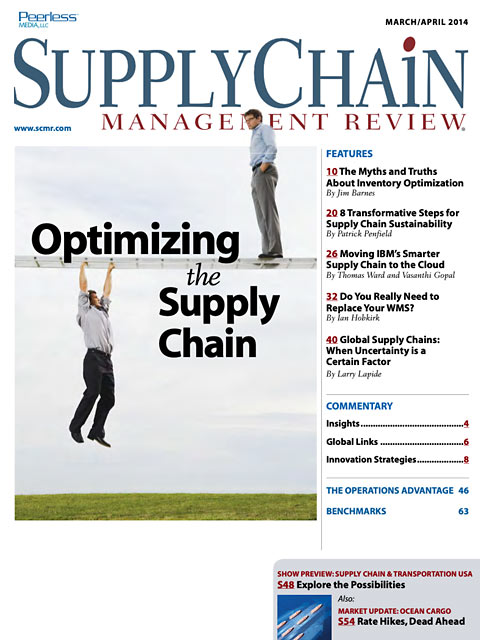
March-April 2014
Retailers and distributors alike have attempted to solve their inventory challenges by using forecasting tools to determine what to buy and when to buy it. A better approach is to change the flow of inventory by reducing cycle times, more effective inventory positioning, and synchronizing supply chains based on the variability of demand. Browse this issue archive.Need Help? Contact customer service 1-508-503-1313 More options
We all dream of a perfect world. For supply chain managers charged with optimizing inventory, especially in the retail industry, Supply Chain Utopia might be a make-to-order environment where a customer walks into a store or visits a Web site to purchase a new shirt to go with a stylish summer outfit. In a matter of minutes, a seamstress turns out a beautiful blue cotton shirt in just the right size. A few minutes later, the shirt is boxed in tissue paper and handed to the happy customer or dropped off at a parcel carrier for the last mile delivery. In Supply Chain Utopia, retailers would always have ample capacity, raw materials, and labor to meet periods of average and peak demand. Inventory optimization would be taught in The History Of Supply Chain 101; inventory managers would bore their grandchildren with stories about distribution centers, stocking points, and back of the store storage rooms from the good old days.
Unfortunately, Supply Chain Utopia is a myth. The truth of today’s competitive markets is that customers want instant purchase gratification while lead times for incoming merchandise can be 20 days to 180 days. That especially holds true for retailers at all stages of the transformation from single channels of business, such as a brick and mortar or catalog retailer, to multi- and omni-channel retailing from stores, catalogs, the Web, and other mediums. But, it also holds true for industrial distributors and manufacturers competing on a greater depth of product, drop shipments, and higher levels of customer service.
This does not mean we should stop developing demand driven retail or distribution supply chain strategies with the concept of buy one and stock (replenish) one. In the meantime, however, most retailers and distributors will struggle to have the right SKU at the right place, in the right quantity, and at the right time to meet the demands of their customers.
 |
This complete article is available to subscribers
only. Click on Log In Now at the top of this article for full access. Or, Start your PLUS+ subscription for instant access. |
Not ready to subscribe, but need this article?
Buy the complete article now. Only $20.00. Instant PDF Download.
Access the complete issue of Supply Chain Management Review magazine featuring
this article including every word, chart and table exactly as it appeared in the magazine.
SC
MR
Sorry, but your login has failed. Please recheck your login information and resubmit. If your subscription has expired, renew here.
March-April 2014
Retailers and distributors alike have attempted to solve their inventory challenges by using forecasting tools to determine what to buy and when to buy it. A better approach is to change the flow of inventory by… Browse this issue archive. Access your online digital edition. Download a PDF file of the March-April 2014 issue. |
Download Article PDF |
We all dream of a perfect world. For supply chain managers charged with optimizing inventory, especially in the retail industry, Supply Chain Utopia might be a make-to-order environment where a customer walks into a store or visits a Web site to purchase a new shirt to go with a stylish summer outfit. In a matter of minutes, a seamstress turns out a beautiful blue cotton shirt in just the right size. A few minutes later, the shirt is boxed in tissue paper and handed to the happy customer or dropped off at a parcel carrier for the last mile delivery. In Supply Chain Utopia, retailers would always have ample capacity, raw materials, and labor to meet periods of average and peak demand. Inventory optimization would be taught in The History Of Supply Chain 101; inventory managers would bore their grandchildren with stories about distribution centers, stocking points, and back of the store storage rooms from the good old days.
Unfortunately, Supply Chain Utopia is a myth. The truth of today’s competitive markets is that customers want instant purchase gratification while lead times for incoming merchandise can be 20 days to 180 days. That especially holds true for retailers at all stages of the transformation from single channels of business, such as a brick and mortar or catalog retailer, to multi- and omni-channel retailing from stores, catalogs, the Web, and other mediums. But, it also holds true for industrial distributors and manufacturers competing on a greater depth of product, drop shipments, and higher levels of customer service.
This does not mean we should stop developing demand driven retail or distribution supply chain strategies with the concept of buy one and stock (replenish) one. In the meantime, however, most retailers and distributors will struggle to have the right SKU at the right place, in the right quantity, and at the right time to meet the demands of their customers.
|
SUBSCRIBERS: Click here to download PDF of the full article. |
SC
MR

Latest Supply Chain News
- Schneider Electric’s Jackie Zhu: Why the best leaders build careers across the business
- AI is driving change in supply chain skills and talent
- 4 moves supply chains must make as AI triggers a memory supply shock
- Innovators Netstock, Pickle Robot win NextGen Solution Provider awards
- Bigger trucks versus broken bridges and roads
- More News
Latest Podcast

 Explore
Latest Supply Chain News
- Innovators Netstock, Pickle Robot win NextGen Solution Provider awards
- Bigger trucks versus broken bridges and roads
- From salon to dock door: Repurposing scheduling software for inbound flow
- The biggest barrier to AI in supply chains isn’t technology
- Rebuilding a planning function around the physical world
- Why companies blame the wrong supplier … and miss the real failure
- More latest news
Latest Resources
Subscribe

Supply Chain Management Review delivers the best industry content.

Editors’ Picks



