
It’s never easy to bring on a new line in a factory, especially one with a high level of automation and new technologies. Often, the work is done during off-shift hours and on the weekends so it doesn’t interrupt production. It’s typically an all hands-on deck ordeal that reminds me of the old line about changing a tire while rolling down the highway.
Now, imagine pulling it off in the middle of a pandemic. That’s exactly what the dishwasher team at GE Appliances did in Louisville in 2020. “It was definitely a ‘whatever it takes year’ to navigate the surge in demand for appliances and the pandemic,” a GE Appliances spokesperson told me before my interview with Cinthy Fanning, vice president for dishwashers, and Alison Seward, senior director for the dishwasher program.
The new $80 million line will generate a 20% increase in capacity and 140 additional jobs, with another 140 being added across the 750-acre manufacturing complex. But more than that, it’s part of the overall investment GE Appliances is making in its Digital Supply Chain initiative. That’s something I previously wrote about in the November 2019 issue of Modern Materials Handling. It was also highlighted in a keynote presentation by Mark Shirkness, vice president of distribution, at the NextGen Supply Chain Conference I hosted last November. GE Appliances was also the recipient of one of our 2020 NextGen supply chain awards.
According to Cinthy Fanning, planning for the new production line began in 2017; Alison Seward and her team joined the project in 2018. The line was designed to fill a gap in the company’s product portfolio. “We needed to lower the manufacturing cost of the extra-large capacity product in several of our brands to be more competitive at retail prices,” Fanning said. In addition to the entry-level Hotpoint brand, GE is one of GE Appliances’ mass market brands, where consumers are especially price conscious.
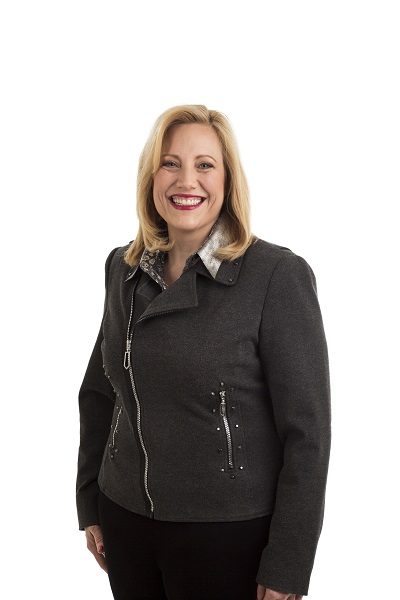
Cinthy Fanning, vice president, dishwashers
Cost was a business goal. But, according to Seward, there were also operational goals for the new line. “This was the first project in our product architecture journey,” she noted. That translates to the use of common parts, common processes and common technologies that can then be applied to other lines in the facility as they are updated.
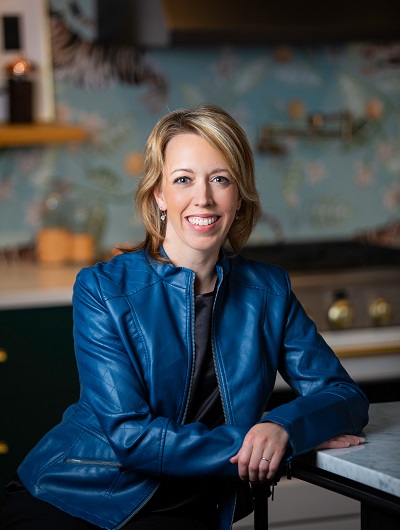
Alison Seward, senior director, dishwasher program
It is particularly applicable to the Louisville plant, where “all of the GE Appliances’ dishwasher brands are manufactured under one roof, albeit on different assembly lines,” Fanning said. Economies of scale and synergies can be achieved if new technologies that work on one line, like some of the new robots installed, can be applied to future upgrades of other lines, or when a portfolio of products can share “under the hood” parts that are not impactful to the aesthetics of the different machines.
A third goal that impacted the design of the line was to create a safe and ergonomic work area to improve the operator experience – a happier operator would be more efficient and potentially reduce turnover. “A lot of ergonomic simulation went into the design of the line,” Seward said. “We created a digital layout of the workspace with digital mannequins that allowed us to make adjustments to accommodate men and women.”
But it wasn’t just simulation. The salaried team worked on the line to better understand the jobs and processes they were engineering. “Our gasket engineer spent a day installing gaskets on dishwashers,” Seward pointed out. “We had multiple engineers work on installing an assembly that went into a tub. They found a better way to accomplish that which involves both robotics and a new process that allows associates to stand rather than sit, which is safer.” In addition to that hands-on experience, 6 hourly team leaders who run the production lines joined the design project about 18 months before the launch. They were able to identify and offer solutions to problems that might not be obvious to the engineers.
The last piece of the design was to incorporate more automation. This included more robotics, which are already utilized in other areas of the facility, and automatic guided vehicles to deliver parts to the line. “We operate fork truck-free delivery in the main area of the assembly line,” Seward noted.
Following an extensive design and testing phase, implementation began in 2020. “Basically, we built, installed and started production in the middle of a pandemic,” Fanning said.
With the pandemic surging last spring, GE Appliances implemented a weeklong pause across its manufacturing sites to install plexiglass dividers between workstations and in break areas, along with 6-foot distance markers. At the corporate level, the company created a war room to address business continuity through three lenses: How could the company protect people, continue to serve its customers and support the communities where it did business? “To be considered an essential business activity, it had to support those three things,” Fanning said.
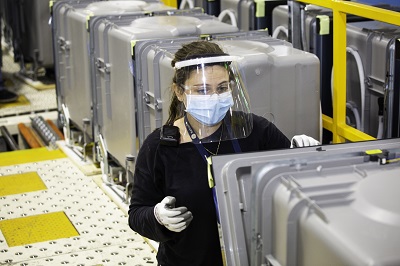
The new line met the criteria for an essential business activity. To keep operating, a new playbook was created, one that involved enhanced Personal Protection Equipment in the workplace, a health screen questionnaire before people came onto the site and no touch temperature scanning. For instance, before employees or contractors were allowed on the floor, they had to suit up with face masks and shields and gloves. “You don’t realize how much you read lips on a production floor until everyone has a mask on,” Seward joked.
Anyone who didn’t need to be onsite to complete their job, worked off site. Meetings were both virtual and scaled back to accommodate team members who were now dealing with day care and home learning due to school closures. “There were times that some team members who didn’t have kids at home still had to quarantine because of exposure,” Fanning said. “We took the attitude that it’s tough everywhere, and we just have to do this together.”
Despite those challenges, new appliances began rolling off the state-of-the-art line in November. Getting that done during a pandemic was impressive. But another reason I wanted to talk to Fanning and Seward is that they are women in senior operating roles in manufacturing. It’s something we don’t see every day but also something to encourage. I asked both what brought them into the field, and what keeps them here.
Fanning’s route to the shop floor was circuitous. She began her career in technology, followed by stints in sales, quality control, marketing and finally product management. “I had a broad background with different elements to it,” she said. “But I loved end-to-end accountability, or working on projects from the beginning all the way to the customer. That’s how I got here.”
For Seward, going into manufacturing was intentional. An engineer by education, her father was a plant manager. “I remember as a kid going into the plant on Sundays with my Dad, so it was natural for me,” she said. “Being out in the plant is what I like to do, and the pace of it is invigorating. The fact that the products we make are in half the homes in America keeps me here.”
They both are involved in mentoring, and champion working mother’s in a field in which historically, the job came first. “I like to say that you can be a woman in manufacturing and a mom in manufacturing,” Seward said. “Sometimes work is more pressing and sometimes home is more pressing, so you have to find the balance that works for you. But, I think the more we can be visible to other women, the better.”
Click here to view a video about GE Appliances’ new line.
SC
MR

Latest Supply Chain News
- Innovators Netstock, Pickle Robot win NextGen Solution Provider awards
- Bigger trucks versus broken bridges and roads
- From salon to dock door: Repurposing scheduling software for inbound flow
- The biggest barrier to AI in supply chains isn’t technology
- Rebuilding a planning function around the physical world
- More News
Latest Podcast
 Explore
Latest Supply Chain News
- Why companies blame the wrong supplier … and miss the real failure
- NextGen Supply Chain Conference unveils agenda focused on AI, execution and the future of leadership
- From fragmented negotiations to coordinated negotiation performance: an AI-enabled approach
- Supply chain resilience isn’t a data problem; it’s a judgment problem
- Beyond the hype: Building flexible and scalable supply chains in a VUCA world
- Why your supply chain risk management plan will fail
- More latest news
Latest Resources
About the Author
Bob Trebilcock, MMH Executive Editor and SCMR contributor

Bob Trebilcock is the editorial director for Modern Materials Handling and an editorial advisor to Supply Chain Management Review. He has covered materials handling, technology, logistics, and supply chain topics for nearly 40 years. He is a graduate of Bowling Green State University. He lives in Chicago and can be reached at 603-852-8976.
Follow SCMR on social media.
@SupplyChainManagementReview on Facebook
@SCMR on Twitter
SCMR on Linkedin
Subscribe

Supply Chain Management Review delivers the best industry content.

Editors’ Picks



