
Sorry, but your login has failed. Please recheck your login information and resubmit. If your subscription has expired, renew here.
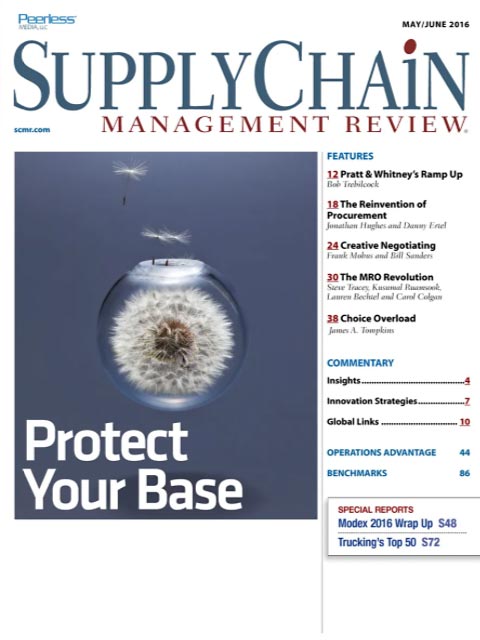
May-June 2016
The procurement function is at an inflection point.” So begins “The reinvention of procurement," an article by Jonathan Hughes and Danny Ertel, partners at the Boston-based consulting firm Vantage Partners. The authors argue that while many leading companies have transformed their procurement organizations into a linchpin of their enterprise strategy, far too many others remain trapped by procurement models that are out of date in today’s fastpaced economy, where the acquisition of innovation, collaboration, services and solutions is more important than transactions based on the lowest cost per unit. Reinvention is a fitting theme for… Browse this issue archive.Need Help? Contact customer service 1-508-503-1313 More options
Transitioning to an omni-channel supply chain undoubtedly brings many challenges for retailers. However, omni-channel is also a major source of supply chain innovation (see Figure 1). The journey involves multiple changes that are forcing companies to rethink the way they design, build, implement, and manage global supply chains, as well as how they relate to key supply chain players.
Fashion company Desigual is deep into its migration to an omni-channel model. The transition is on track for a successful completion and the strategy has already spawned a number of innovative approaches that will benefit its business. These include two areas of fundamental change. One concerns operational activities such as inventory management, as well as broad logistics transformations that are making the company more flexible and agile. The second area pertains to redefining Desigual’s customer relationships, again, under the premise of leveraging the company’s unique brand.
Distinctive style
Desigual was created in Barcelona, Spain, in 1984 by entrepreneur Thomas Meyer. The company now has nearly 5,000 employees, and in 2015 reported annual sales of 933 million euros.
 |
This complete article is available to subscribers
only. Click on Log In Now at the top of this article for full access. Or, Start your PLUS+ subscription for instant access. |
SC
MR
Sorry, but your login has failed. Please recheck your login information and resubmit. If your subscription has expired, renew here.
May-June 2016
The procurement function is at an inflection point.” So begins “The reinvention of procurement," an article by Jonathan Hughes and Danny Ertel, partners at the Boston-based consulting firm Vantage Partners.… Browse this issue archive. Access your online digital edition. Download a PDF file of the May-June 2016 issue. |
Download Article PDF |
Transitioning to an omni-channel supply chain undoubtedly brings many challenges for retailers. However, omni-channel is also a major source of supply chain innovation (see Figure 1). The journey involves multiple changes that are forcing companies to rethink the way they design, build, implement, and manage global supply chains, as well as how they relate to key supply chain players.
Fashion company Desigual is deep into its migration to an omni-channel model. The transition is on track for a successful completion and the strategy has already spawned a number of innovative approaches that will benefit its business. These include two areas of fundamental change. One concerns operational activities such as inventory management, as well as broad logistics transformations that are making the company more flexible and agile. The second area pertains to redefining Desigual's customer relationships, again, under the premise of leveraging the company's unique brand.
Distinctive style
Desigual was created in Barcelona, Spain, in 1984 by entrepreneur Thomas Meyer. The company now has nearly 5,000 employees, and in 2015 reported annual sales of 933 million euros.
|
SUBSCRIBERS: Click here to download PDF of the full article. |
SC
MR

Latest Supply Chain News
- The biggest barrier to AI in supply chains isn’t technology
- Rebuilding a planning function around the physical world
- Why companies blame the wrong supplier … and miss the real failure
- NextGen Supply Chain Conference unveils agenda focused on AI, execution and the future of leadership
- From fragmented negotiations to coordinated negotiation performance: an AI-enabled approach
- More News
Latest Podcast
 Explore
Topics
Latest Supply Chain News
- Why companies blame the wrong supplier … and miss the real failure
- NextGen Supply Chain Conference unveils agenda focused on AI, execution and the future of leadership
- From fragmented negotiations to coordinated negotiation performance: an AI-enabled approach
- Supply chain resilience isn’t a data problem; it’s a judgment problem
- Beyond the hype: Building flexible and scalable supply chains in a VUCA world
- Why your supply chain risk management plan will fail
- More latest news
Latest Resources

Subscribe

Supply Chain Management Review delivers the best industry content.

Editors’ Picks



