
Sorry, but your login has failed. Please recheck your login information and resubmit. If your subscription has expired, renew here.
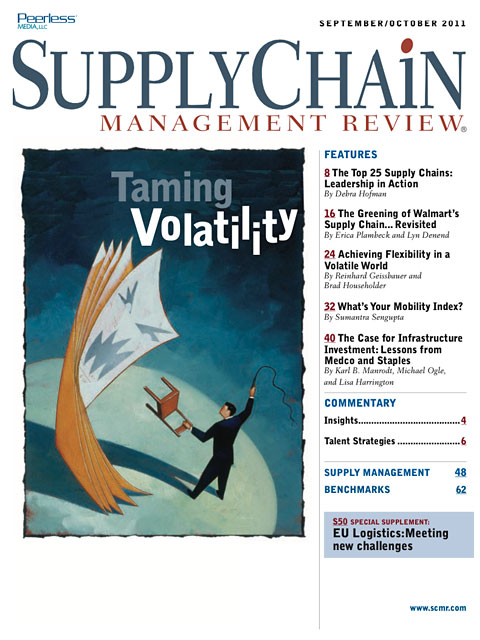
September-October 2011
Volatility has always been a factor in supply chain management. It just seems that the level of volatility we’ve been experiencing recently has been higher—and certainly a lot more persistent—than anything we’ve experienced in quite a while. Those boring good old days of relative stability have been supplanted by economic turmoil and wild stock market swings; by monumental natural disasters like earthquakes, hurricanes, and tornados; by political upheavals around the globe; and by suppliers cutting way back on capacity or in some cases simply going out of business. These are among the major contributors to that sense of volatility that seems… Browse this issue archive.Need Help? Contact customer service 1-508-503-1313 More options
For many years, conventional wisdom defined supply chain management as a quest for the lowest possible price, the leanest processes with the shortest throughput time, and the lowest level of risk. But, over the last three years, global supply chain managers have experienced a paradigm shift: Economic, business, political, and even geological factors have led to unprecedented volatility and uncertainty. In this new business world, supply chain flexibility is not just a source of competitive advantage—it is fundamental to staying in business. Today, the supply chain manager’s mission is to meet customer needs, despite unpredictable swings in customer demand and the availability of resources.
Between 2008 and 2011, the community of global supply chain managers has seen dramatic shifts in focus from a strong push for growth (2008) to managing the implications of the economic crisis (2009), which required full focus on cash control and survival. Then, in 2010, optimism returned and companies put growth back on the agenda. We expect that 2011/2012 will find many executives wondering why revenue growth cannot be faster—and how natural disasters like 2011’s devastating Pacific Rim earthquakes will affect both operations and sales.
As a result, volatility has become the “new normal” for global supply chains. Cost control and efficiency will always be important, but, from now on, companies won’t be able to reap the rewards of efforts on those fronts unless they can build real flexibility into their processes.
In preparing PRTM’s 2010–2012 Global Supply Chain Trends report last year, we noticed that attention to flexibility has, in fact, become a constant. Hence, in the spring of 2011 we conducted a follow-on study dedicated to explaining which levers can increase supply chain flexibility, as well as what leading companies are doing differently from their industry peers. Drawing from interviews conducted with 150 global executives across a broad range of industries, we have identified five key levers, which are discussed in detail below.
 |
This complete article is available to subscribers
only. Click on Log In Now at the top of this article for full access. Or, Start your PLUS+ subscription for instant access. |
Not ready to subscribe, but need this article?
Buy the complete article now. Only $20.00. Instant PDF Download.
Access the complete issue of Supply Chain Management Review magazine featuring
this article including every word, chart and table exactly as it appeared in the magazine.
SC
MR
Sorry, but your login has failed. Please recheck your login information and resubmit. If your subscription has expired, renew here.
September-October 2011
Volatility has always been a factor in supply chain management. It just seems that the level of volatility we’ve been experiencing recently has been higher—and certainly a lot more persistent—than anything… Browse this issue archive. Download a PDF file of the September-October 2011 issue. |
Download Article PDF |
For many years, conventional wisdom defined supply chain management as a quest for the lowest possible price, the leanest processes with the shortest throughput time, and the lowest level of risk. But, over the last three years, global supply chain managers have experienced a paradigm shift: Economic, business, political, and even geological factors have led to unprecedented volatility and uncertainty. In this new business world, supply chain flexibility is not just a source of competitive advantage—it is fundamental to staying in business. Today, the supply chain manager’s mission is to meet customer needs, despite unpredictable swings in customer demand and the availability of resources.
Between 2008 and 2011, the community of global supply chain managers has seen dramatic shifts in focus from a strong push for growth (2008) to managing the implications of the economic crisis (2009), which required full focus on cash control and survival. Then, in 2010, optimism returned and companies put growth back on the agenda. We expect that 2011/2012 will find many executives wondering why revenue growth cannot be faster—and how natural disasters like 2011’s devastating Pacific Rim earthquakes will affect both operations and sales.
As a result, volatility has become the “new normal” for global supply chains. Cost control and efficiency will always be important, but, from now on, companies won’t be able to reap the rewards of efforts on those fronts unless they can build real flexibility into their processes.
In preparing PRTM’s 2010–2012 Global Supply Chain Trends report last year, we noticed that attention to flexibility has, in fact, become a constant. Hence, in the spring of 2011 we conducted a follow-on study dedicated to explaining which levers can increase supply chain flexibility, as well as what leading companies are doing differently from their industry peers. Drawing from interviews conducted with 150 global executives across a broad range of industries, we have identified five key levers, which are discussed in detail below.
|
SUBSCRIBERS: Click here to download PDF of the full article. |
SC
MR

Latest Supply Chain News
- From salon to dock door: Repurposing scheduling software for inbound flow
- The biggest barrier to AI in supply chains isn’t technology
- Rebuilding a planning function around the physical world
- Why companies blame the wrong supplier … and miss the real failure
- NextGen Supply Chain Conference unveils agenda focused on AI, execution and the future of leadership
- More News
Latest Podcast
 Explore
Latest Supply Chain News
- Why companies blame the wrong supplier … and miss the real failure
- NextGen Supply Chain Conference unveils agenda focused on AI, execution and the future of leadership
- From fragmented negotiations to coordinated negotiation performance: an AI-enabled approach
- Supply chain resilience isn’t a data problem; it’s a judgment problem
- Beyond the hype: Building flexible and scalable supply chains in a VUCA world
- Why your supply chain risk management plan will fail
- More latest news
Latest Resources

Subscribe

Supply Chain Management Review delivers the best industry content.

Editors’ Picks



