Sorry, but your login has failed. Please recheck your login information and resubmit. If your subscription has expired, renew here.
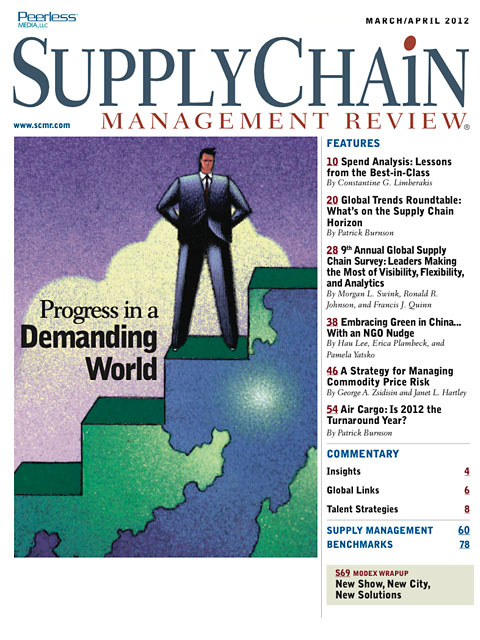
March-April 2012
New research from the Aberdeen Group under-scores the importance of spend analysis. The findings, however, also show a gap between those companies struggling to implement a spend analysis program and the best in class. Aberdeen’s Constantine Limberakis relates the lessons learned from these leaders that can move you up the competency ladder. Browse this issue archive.Need Help? Contact customer service 847-559-7581 More options
As the global economy improves, managers are faced with increasing prices and greater price volatility for key materials and components, energy, and transportation across their supply chains. This article, which is a summary of our recently published book titled Managing Commodity Price Risk: A Supply Chain Perspective (Business Expert Press), describes a flexible approach for managing financial risk from commodity price volatility. When commodity prices are volatile, business decisions associated with developing budgets and profit projections, setting prices, deciding when and how much to buy, and negotiating contracts become all the more challenging.
The wrong decisions can cut into profit margins, reduce cash flows, and damage relationships with suppliers and customers. To cite one example, in 2011 Kimberly-Clark saw its profits and sales drop due in part to higher than- expected prices for wood pulp.1 As a result, the consumer products company was forced to raise prices on diapers, a product category experiencing declining sales and increasing competition from store brands.
Commodities are goods that are not differentiated in the marketplace such as metals, energy, and agricultural products. Commodity prices are influenced by supply and demand as well as by trading and speculation; thus, they can be highly volatile. To illustrate, from August 2003 to March 2004, world soybean prices rose from $237 to $413 per ton, an increase of 74 percent. They then fell back down to $256 over the next 24 months. More recently, silver was trading at around $18 per ounce in April and May of 2010. Less than a year later, silver almost tripled in value to $49 per ounce during the final week of April 2011.2 As global economic development increases the worldwide demand for commodities (many of which have a limited supply), prices and volatility will likely continue to increase.
 |
This complete article is available to subscribers
only. Click on Log In Now at the top of this article for full access. Or, Start your PLUS+ subscription for instant access. |
Not ready to subscribe, but need this article?
Buy the complete article now. Only $20.00. Instant PDF Download.
Access the complete issue of Supply Chain Management Review magazine featuring
this article including every word, chart and table exactly as it appeared in the magazine.
SC
MR
Sorry, but your login has failed. Please recheck your login information and resubmit. If your subscription has expired, renew here.
March-April 2012
New research from the Aberdeen Group under-scores the importance of spend analysis. The findings, however, also show a gap between those companies struggling to implement a spend analysis program and the best in… Browse this issue archive. Download a PDF file of the March-April 2012 issue.|
|
Download Article PDF |
As the global economy improves, managers are faced with increasing prices and greater price volatility for key materials and components, energy, and transportation across their supply chains. This article, which is a summary of our recently published book titled Managing Commodity Price Risk: A Supply Chain Perspective (Business Expert Press), describes a flexible approach for managing financial risk from commodity price volatility. When commodity prices are volatile, business decisions associated with developing budgets and profit projections, setting prices, deciding when and how much to buy, and negotiating contracts become all the more challenging.
The wrong decisions can cut into profit margins, reduce cash flows, and damage relationships with suppliers and customers. To cite one example, in 2011 Kimberly-Clark saw its profits and sales drop due in part to higher than- expected prices for wood pulp.1 As a result, the consumer products company was forced to raise prices on diapers, a product category experiencing declining sales and increasing competition from store brands.
Commodities are goods that are not differentiated in the marketplace such as metals, energy, and agricultural products. Commodity prices are influenced by supply and demand as well as by trading and speculation; thus, they can be highly volatile. To illustrate, from August 2003 to March 2004, world soybean prices rose from $237 to $413 per ton, an increase of 74 percent. They then fell back down to $256 over the next 24 months. More recently, silver was trading at around $18 per ounce in April and May of 2010. Less than a year later, silver almost tripled in value to $49 per ounce during the final week of April 2011.2 As global economic development increases the worldwide demand for commodities (many of which have a limited supply), prices and volatility will likely continue to increase.
|
|
SUBSCRIBERS: Click here to download PDF of the full article. |
SC
MR

Latest Supply Chain News
- Developing supply chain talent for new product development
- Finance as a transformation catalyst: A How-To guide for supply chain finance leaders
- Procurement’s Moneyball Moment: Connecting Strategy, Sourcing, and Supply Chain Reality
- AI won’t fix a broken supply chain foundation
- How I vibe-coded an S&OP app in 30 hours
- More News
Latest Resources

 Explore
Latest Supply Chain News
- PepsiCo moves its startup sustainability program from pilots to operational scale across Asia Pacific
- Eli Lilly’s Mar Gimeno to keynote at NextGen Supply Chain Conference 2026
- Agentic coding and the future of supply chain leadership
- From orbit to operations: Winning the race for the earliest disruption signal
- Stop moving boxes, start moving dollars: The new math of global supply chain velocity
- Finding your rhythm: SME supply chain footwork when the rules keep changing
- More latest news
Latest Resources

Subscribe

Supply Chain Management Review delivers the best industry content.

Editors’ Picks