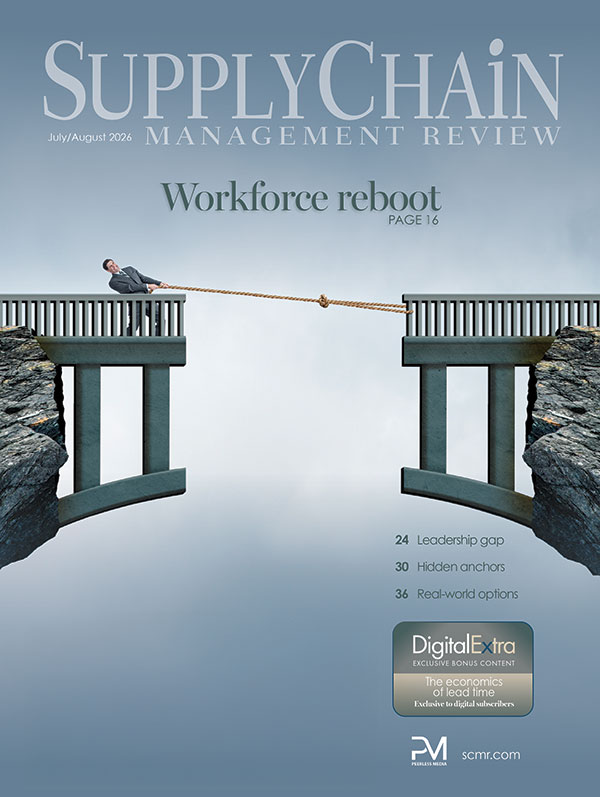
July-August 2026
The July issue of Supply Chain Management Review explores how organizations are preparing for the future through workforce development, AI adoption, leadership education, and supply chain resilience. Features examine closing the skills gap, building AI-enabled teams, strengthening supplier networks, and developing practical strategies for navigating disruption in an increasingly complex global marketplace.
Not a subscriber?
Subscribe today
1
Technology isn’t strategy
The rush to implement AI, robotics, and other automation solutions isn’t the key to success; but it is a holistic approach to solving your pain points.
12
The AI-empowered supply chain leader
If you believe the headlines, AI is about to put global supply chains on autopilot, quietly sidelining planners, buyers, and logistics managers. That may make for great…
16
The value proposition: Bridging the skills gap between the SCM degree and the workplace
As AI, geopolitical volatility, and sustainability mandates rapidly reshape supply chain operations, universities and industry partners face growing pressure to redesign SCM…
24
Developing the next generation of supply chain leaders: Is higher education serving the needs of the marketplace?
As supply chain management has evolved into a broader value chain leadership discipline, universities face growing pressure to redesign curriculum around risk, resilience,…
30
Nexus suppliers: Hidden anchors of resilience in decentralized supply chains
As supply chains become more decentralized and fragmented, resilience increasingly depends not on the number of suppliers in the network, but on “nexus suppliers” whose…
36
What options do you really have? Shaping the supply chain resilience funnel
Before investing in supply chain resilience, map your real option space—then decide what is feasible, useful, and usable under pressure.
4
Chokepoints need the ‘Theory of Constraints’
As geopolitical tensions expose vulnerabilities in global trade routes, supply chain leaders can apply the “Theory of Constraints” to identify chokepoints, build strategic…
40
Lead time economics: What semiconductor supply chains reveal about strategic planning
As AI-driven demand, geopolitical volatility, and massive capital requirements collide, semiconductor supply chains are becoming a blueprint for how capital-intensive industries…
44
Risk sharing is the new advantage in capital project delivery
As labor shortages, capacity constraints, and record infrastructure spending reshape capital markets, leading organizations are turning to risk-sharing contracts to improve…
48
Managing human and AI teams across the supply chain
Supply chain teams operate in environments where conditions can change by the hour (or faster). To keep pace, many organizations are embedding AI directly into their workflows.…
52
Finding the ROI in supply chain education
As supply chain roles expand, professionals and companies are looking harder at which certifications and programs deliver the best return on investment.
8
From rules of origin to rules of resilience
For decades, trade agreements have focused on fundamental components: product or service features, markets, regulatory standards, investment protections, and dispute resolution.…